
Chapter 5 - FIRST DAYS IN ADELIE LAND
The Home of the Blizzard By Douglas Mawson
Preface
Chapters:
1 - The Problem
and Preparations |
2 - The Last
Days of Hobart and the Voyage to Macquarie Island |
3 - From Macquarie
Island to Adelie Land |
4 - New Lands
| 5 - First
Days in Adelie Land |
6 - Autumn
Prospects |
7 - The Blizzard |
8 - Domestic
Life | 9
- Midwinter and its Work |
10 - The
Preparation of Sledging Equipment |
11 - Spring
Exploits |
12 - Across King George V Land |
13 - Toil
and Tribulation |
14 -
The Quest of the South Magnetic Pole
| 15
- Eastward Over the Sea-Ice |
16 - Horn
Bluff and Penguin Point |
17 - With
Stillwell's and Bickerton's Parties |
18 - The
Ship's Story |
19 - The
Western Base - Establishment and Early Adventures |
20 - The
Western base - Winter and Spring |
21 - The
Western Base - Blocked on the Shelf-Ice |
22 - The
Western base - Linking up with Kaiser Wilhelm II Land
| 23 - A
Second Winter |
24 - Nearing
the End |
25 - Life on Macquarie Island |
26 - A Land
of Storm and Mist |
27- Through
Another Year |
28 - The
Homeward Cruise
Appendices:
2 - Scientific Work
| 3 - An Historical
Summary | 4
- Glossary |
5 - Medical Reports |
6 - Finance
| 7 - Equipment
Summary (2 pages) of the
Australian Antarctic Expedition
| The
Men of the Expedition
CHAPTER V
FIRST DAYS IN ADELIE LAND
The overcrowded whale-boat disgorged its cargo
at 10 P.M. on the ice-quay at Cape Denison. The only shelter
was a cluster of four tents and the Benzine Hut, so the first
consideration was the erection of a commodious living-hut.
While the majority retired to rest to be ready for a fresh
burst of work on the morrow, a few of us discussed the preliminary
details, and struck the first blows in the laying of the foundations.
A site for the living-hut was finally approved. This
was a nearly flat piece of rocky ground of just sufficient size,
partially sheltered on the southern side by a large upstanding
rock. Other points to recommend it were, proximity to the boat
harbour and to a good sledging surface; the ice of the glacier
extending to the ``front door'' on the western side.
Several large rocks had to be shifted, and difficulty was anticipated
in the firm setting of the stumps. The latter were blocks of
wood, three feet in length, embedded in the ground, forming
the foundation of the structure. Unfortunately, no such thing
as earth or gravel existed in which to
sink these posts,
and the rock being of the variety known as gneiss, was more
than ordinarily tough.
Since two parties had combined,
there were two huts available, and these were to be erected
so that the smaller adjoined and was in the lee of the larger.
The latter was to be the living-room; the former serving as
a vestibule, a workshop and an engine-room for the wireless
plant. Slight modifications were made in the construction of
both huts, but these did not affect the framework. After the
completion of the living-hut, regular scientific observations
were to commence, and the smaller hut was then to be built as
opportunity offered.
Nothing has so far been said about
the type of hut adopted by our Antarctic stations. As the subject
is important, and we had expended much thought thereon before
coming to a final decision, a few remarks
will not be out
of place.
Strength to resist hurricanes, simplicity of
construction, portability and resistance to external cold were
fundamental. My first idea was to have the huts in the form
of pyramids on a square base, to ensure stability in heavy winds
and with a large floor-area to reduce the amount of timber used.
The final type was designed at the expense of floor-space, which
would have been of little use because of the low roof in the
parts thus eliminated. In this form, the pyramid extended to
within five feet of the ground on the three windward sides so
as to include an outside veranda. That veranda, like the motor-launch,
was a wonderful convenience, and another of the many things
of which we made full use. It lent stability to the structure,
assisted to keep the hut warm, served as a store-house, physical
laboratory and a dogshelter.
Round the outside of the
three veranda walls boxes of stores were stacked, so as to continue
the roof-slope to the ground. Thus, the wind striking the hut
met no vertical face, but was partly deflected; the other force-component
tending to pin the building to the ground.
All three
huts were essentially of the same construction. The largest,
on account of its breadth, had four special supporting posts,
symmetrically placed near the centre, stretching from the ground
to the roof framework. The only subdivisions inside were a small
vestibule, a photographic darkroom and my own room. This rough
idea I had handed over to Hodgeman, leaving him to complete
the details and to draw up the plans. The frame timbers he employed
were stronger than usual in a building of the size, and were
all securely bolted together. The walls and roof, both inside
and outside, were of tongued and grooved pine-boards, made extra
wind-proof by two courses of tarred paper. As rain was not expected,
this roofing was sufficient. There were four windows in the
roof, one on each side of the pyramid. We should thereby get
light even though almost buried in snow.
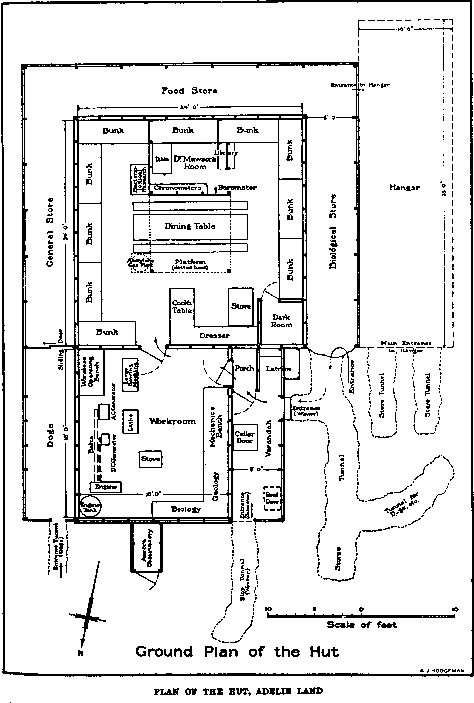
Plan of the hut, Adelie Land
The largest hut was presented by the timber
merchants of Sydney, and proved its astonishing strength during
the winter hurricanes. The smallest was purchased in Adelaide,
the third was built and presented by Messrs. Anthony of Melbourne.
On the morning of January 20 all were at work betimes. As
we were securely isolated from a trades hall, our hours of labour
ranged from 7 A.M. till 11 P.M.
Dynamite was to be used
for blasting out the holes for the reception of the stumps,
and so the steel rock-drills were unpacked and boring commenced.
This was easier than it appeared, because the rock was much
traversed by cracks. By the end of the day a good deal of damage
had been done to the rock, at the expense of a few sore fingers
and wrists caused by the sledge-hammers missing the drills.
The work was tedious, for water introduced into the holes had
a habit of freezing. The metal drills, too, tended to be brittle
in the cold and
required to be tempered softer than usual.
Hannam operated the forge, and picks and drills were sent along
for pointing; an outcrop of gneiss serving as an anvil.
Among other things it was found difficult to fire the charges, for, when frozen, dynamite is not readily exploded. This was overcome by carrying the sticks inside one's pocket until the last moment. In the absence of earth or clay, we had no tamping material until some one suggested guano from the penguin rookeries, which proved a great success.
Next day the stumps were in place; most of them
being fixed by wedges and other devices. Cement was tried, but
it is doubtful if any good came of it, for the low temperature
did not encourage it to set well. By the evening, the bottom
plates were laid on and bolted to the tops of the stumps, and
everything was ready for the superstructure.
On January
22, while some were busy with the floor-joists and wall-frames,
others carried boulders from the neighbouring moraine, filling
in the whole space between the stumps. These were eventually
embedded in a mass of boulders, as much as three feet deep in
places. By the time both huts were erected, nearly fifty tons
of stones had been used in the foundations--a circumstance we
did not regret at a later date.
Hodgeman was appointed
clerk of works on the construction, and was kept unusually busy
selecting timber, patrolling among the workmen, and searching
for his foot-rule which had an unaccountable trick of
vanishing
in thin air.
Hannam had various occupations, but one
was to attend to the needs of the inner man, until the completion
of the hut. There is no doubt that he was regarded at this time
as the most important and popular member of the party, for our
appetites were abnormally good. About an hour before meals he
was to be seen rummaging amongst the cases of provisions, selecting
tins of various brands and hues from the great confusion. However
remote their source or diverse their colour, experience taught
us that only one preparation would emerge from the tent-kitchen.
It was a multifarious stew. Its good quality was undoubted,
for a few minutes after the ``dinner-bell rang'' there
was not a particle left. The ``dinner-bell'' was a lusty
shout from the master cook, which was re-echoed by the brawny
mob who rushed madly to the Benzine Hut. Plates and mugs were
seized and portions measured out, while the diners distributed
themselves on odd boxes lying about on the ice. Many who were
accustomed to restaurants built tables of kerosene cases and
dined al fresco. After the limited stew, the company fared on
cocoa, biscuits--``hard tack''--and jam, all ad libitum.
On those rare summer days, the sun blazed down on the blue
ice; skua gulls nestled in groups on the snow; sly penguins
waddled along to inspect the building operations; seals basked
in torpid slumber on the shore; out on the sapphire bay the
milk-white bergs floated in the swell. We can all paint our
own picture of the good times round the Benzine Hut. We worked
hard, ate heartily and enjoyed life.
By the evening of
January 24 the floor and outside walls were finished, and the
roof-frame was in position. Work on the roof was the coldest
job of all, for now there was rarely an hour free from a cold
breeze, at times reaching the velocity of a gale. This came
directly down from the plateau, and to sit with exposed fingers
handling hammer and nails was not an enviable job. To add to
our troubles, the boards were all badly warped from being continually
wet with sea-water on the voyage. However, by judicious ``gadgetting,''
as the phrase went, they were got into place.
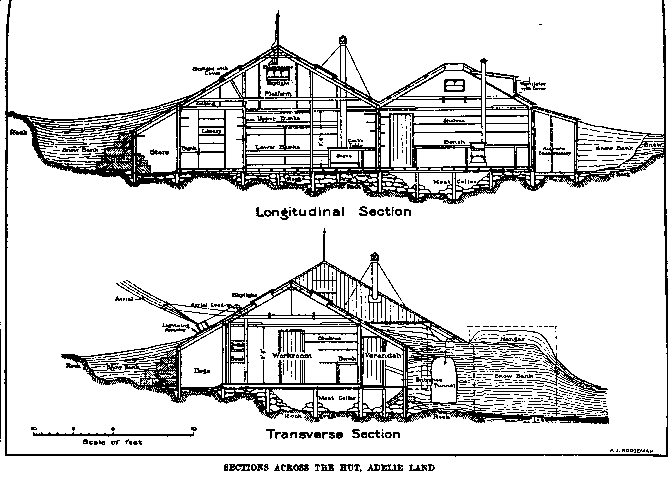
Sections across the hut, Adelie Land
The windward roof was up on January 25, and
several of us camped in sleeping-bags under its shelter. Already
Hannam had unpacked the large range and put the parts together
in the kitchen. Henceforth the cooking operations were simplified,
for previously a sledging-cooker had been used.
Mention
of the stove recalls a very cold episode. It happened that while
our goods were being lifted from the boats to the landing-stage,
a case had fallen into the harbour. When the parts of the stove
were being assembled, several important items were found to
be missing, and it was thought that they might compose the contents
of the unknown case lying in the kelp at the bottom of the bay.
Laseron and I went on board the whale-boat one day at low
water, and located the box with a pole, but though we used several
devices with hooks, we were unable to get hold of it. At last
I went in, and, standing on tip-toe, could just reach it and
keep my head above water. It took some time to extricate from
the kelp, following which I established a new record for myself
in dressing. The case turned out to be full of jam, and we had
to make a new search for the missing parts. I do not think I
looked very exhilarated after that bath, but strange to say,
a few days later Correll tried an early morning swim which was
the last voluntary dip attempted by any one.
The enthusiasm
of the builders rose to its highest pitch as the roof neared
completion, and we came in sight of a firm and solid habitation,
secure from the winds which harassed us daily. A dozen hammers
worked at once, each concentrated upon a specific job. The ardour
with which those engaged upon the ceiling inside the hut plied
their nails resulted in several minor casualties to those sitting
on the roof, deeply intent on the outer lining. A climax was
reached when McLean, working on the steeply inclined roof, lost
his footing and, in passing, seized hold of the wire-stay of
the chimney as a last hope. Alas, that was the only stay, and
as he proceeded over the end of the roof into a bank of snow,
Ninnis, within the hut, convinced that nothing less than a cyclone
had struck the building, gallantly held on to the lower hot
section amidst a shower of soot.
Everybody was in the
best of spirits, and things went ahead merrily. On January 30
the main building was almost completed, and all slept under
its roof. Bunks had been constructed, forming a double tier
around three sides of the room. For the first time since coming
ashore we retired to sleep in blankets; fur sleeping-bags had
been previously used. That night the sky which had been clear
for a fortnight banked up with nimbus cloud, and Murphy, who
was sleeping under a gap in the roof, woke up next morning to
find over him a fine counterpane of snow. He received hearty
congratulations all round.
Regular meteorological observations
began on February 1. The various instruments had been unpacked
as soon as the outer shell of the Hut was completed. The barometer
and barograph were kept running inside. Outside there were two
large screens for the reception of a number of the instruments.
It was important to erect these as near the Hut as possible.
The standard thermometer, thermograph and hygrograph were to
occupy one of the screens, a convenient site for which was chosen
about twenty yards to the east. Close by there was also a nephoscope
for determining the motion of clouds. The immediate vicinity
of the Hut, being a gully-like depression, was unsuitable for
the wind and sunshine recorders. A more distant site, on a rocky
ridge to the east, was chosen for these. There were set
up a recording anemometer (wind-velocity meter), a sunshine-meter
and the second screen containing the anemograph (wind-direction
recorder).
Madigan was to take charge of the meteorological
observations and he, assisted by Ninnis and Mertz, erected the
two screens and mounted the instruments. Special care was taken
to secure the screens against violent winds. Phosphor-bronze
wire-stays, with a breaking strength of one ton, were used,
attached to billets of wood driven into fissures in the rock.
Strong as these wires were, several breakages had to be replaced
during the year.
Webb was busy with the magnetic work.
For this two huts were to be erected; the first for ``absolute''
determinations, the second for housing the recording instruments--the
magnetographs. Distant sites, away from the magnetic disturbances
of the Hut, were chosen. Webb and Stillwell immediately set
to work as soon as they could be spared from the main building.
For the ``absolute hut'' there were only scrap materials
available; the ``magnetograph house,'' alone, had been
brought complete. They had a chilly job, for as the days went
by the weather steadily became worse. Yet in a little over a
week there were only the finishing touches to make, and the
first observations were started.
It was now necessary
to institute a routine of nightwatchmen, cooks and messmen.
The night-watchman's duties included periodic meteorological
observations, attention to the fire in the range, and other
miscellaneous duties arising between the hours of 8 P.M. and
8 A. M. The cook prepared the meals, and the messman of the
day rendered any assistance necessary. A rotation was adopted,
so arranged that those most actively engaged in scientific observations
were least saddled with domestic duties. Thus each contributed
his equivalent share of work.
Whilst others were
occupied finishing off the interior of the hut, Whetter and
Close sledged the cases of stores across from the landing-stage,
classified them and stacked them against the veranda walls.
An additional barricade was constructed of flour cases, in the
form of a wall, which increased the breadth of the rocky break-wind
on the southern side.
Murphy, who was in charge of all
the stores, saw that a good stock of food was accessible in
the veranda. Here he put up shelves and unpacked cases, so that
samples of everything were at hand on the shortest notice. Liquids
liable to freeze and burst their bottles were taken into the
Hut.
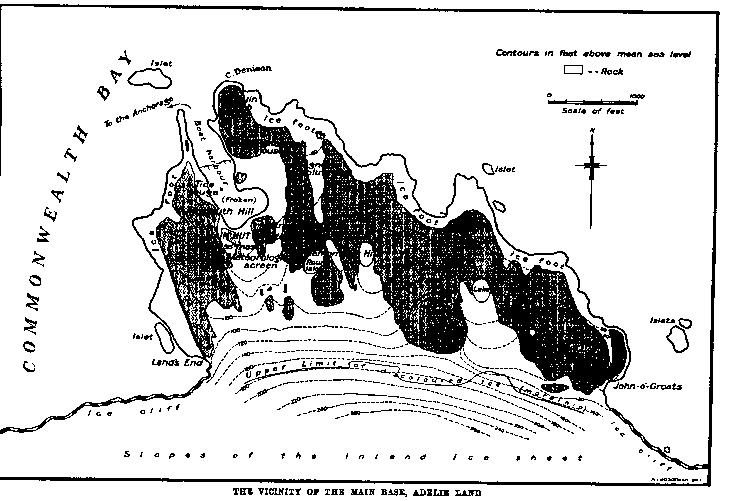
The vicinity of the main base, Adelie
Land
Already we had several times seized the opportunity
of a calm hour to take out the whale-boat and assist Hunter
to set traps and make a few hauls with the hand-dredge. Even
in five fathoms, bright red and brown star-fish had been caught
in the trap, as well as numerous specimens of a common Antarctic
fish known as `Notothenia'. In ten fathoms and over the
results were better, though in no case was the catch so abundant
as one would expect from the amount of life in the water. The
luxuriant kelp probably interfered with the proper
working
of the traps. Fish of the same species as the above were caught
on a hand-line.
Hunter, our biologist, was very unfortunate
in crushing some of his fingers while carrying a heavy case.
This accident came at a time when he had just recovered from
a severe strain of the knee-joint which he suffered during our
activities in the Queen's Wharf shed at Hobart. Several
of us were just going out to the traps one afternoon when the
casualty occurred. Hunter was very anxious to go, so we waited
until McLean had sewn up a couple of his fingertips.
Weddell, and with them occasional crab-eater seals, were at
this time always to be found in numbers sleeping on the ice-foot
around the boat harbour. It appeared as if we would have plenty
of meat throughout the year, so I waited until the building
was completed before laying in a stock. The penguins, however,
were diminishing in numbers fast and the young birds in the
rookeries had grown very large and were beginning to migrate
to warmer regions. Several parties, therefore, raided them and
secured some hundreds for the winter.
Giant petrels and
skua gulls swarmed in flocks round the seals' and penguins'
carcases. These scavengers demolish an incredible amount of
meat and blubber in a short time. It is a diabolical sight to
witness a group of birds tearing out the viscera of a seal,
dancing the while with wings outspread.
During the afternoon
of February 11 Webb came in with the news that a sea elephant
was making its way over the rocks near the shore. We rushed
out in time to see it standing over Johnson, one of the dogs,
who, true to his name, did not look abashed. Attracted by more
formidable antagonists, the monster left Johnson and came towards
us. He was a fair-sized male with a good skin, so we shot him
before he had time to get back into the sea. His measurements
were seventeen feet six inches in length and twelve feet in
maximum circumference.
With the temperature well below
freezing-point, skinning is cold work in the wind, and must
be done before the animal has time to freeze stiff. A number
of us set to work flaying. In order to move the mountain of
flesh a Westing purchase and a ``handy-billy'' (rope
and block purchase) had to be rigged. It was several hours before
everything was disposed of; the skin and skull for the biological
collection and the meat and blubber for the dogs. Ninnis and
Mertz, who were the wardens of the dogs, cut up about one ton
of meat and blubber, and stored it as a winter reserve for their
charges.
It may be mentioned that sea elephants are sub-antarctic
in distribution, and only rarely have these animals been observed
on the shores of the Antarctic continent. As far as I am aware,
the only other occasion of such an occurrence was noted by Captain
Scott in MacMurdo Sound. Wilkes reported many of them on the
pack-ice to the north of the Balleny Islands, so possibly they
have a stronghold in that vicinity.
The dogs, ever since
their arrival ashore, had been chained up on the rocks be]ow
the Hut. The continuous wind worried them a good deal, but they
had a substantial offset to the cold in a plentiful supply of
seal-meat. On the whole, they were in a much better condition
then when they left the `Aurora'. Nineteen in all, they
had an odd assemblage of names, which seemed to grow into them
until nothing else was so suitable: Basilisk, Betli, Caruso,
Castor, Franklin, Fusilier, Gadget, George, Ginger, Ginger Bitch,
Grandmother, Haldane, Jappy, John Bull, Johnson, Mary, Pavlova,
Scott and Shackleton. Grandmother would have been better known
as Grandfather. He was said to have a grandmotherly appearance;
that is why he received the former name. The head dog was Basilisk,
and next to him came Shackleton.
Early in February, after
having experienced nothing but a succession of gales for nearly
a month, I was driven to conclude that the average local weather
must be much more windy than in any other part of Antarctica.
The conditions were not at all favourable for sledging, which
I had hoped to commence as soon as the Hut was completed. Now
that the time had arrived and the weather was still adverse,
it seemed clear that our first duty was to see everything snug
for the winter before making an attempt.
Hannam, assisted
by Bickerton, Madigan and others, had laid heavy and firm foundations
for the petrol-motor and generator. The floor of the smaller
room was then built around these bed-plates, and last of all
came the walls and roof. Murphy, Bage and Hodgeman were chiefly
responsible for the last-named, which was practically completed
by February 10. Minor additions and modifications were added
after that date. Meanwhile, Hannam continued to unpack and mount
the instruments forming the wireless plants. Along one wall
and portion of another, in the outer hut, a bench was built
for mechanical work and for scientific purposes. This was in
future to be the work-room.
Our home had attained to
a stage of complex perfection. To penetrate to the inside hut,
the stranger reverently steps through a hole in the snow to
the veranda, then by way of a vestibule with an inner and outer
door he has invaded the privacy of the work-room, from which
with fear and trembling he passes by a third door into the sanctum
sanctorum. Later, when the snow-tunnel system came into vogue,
the place became another Labyrinth of Minos.
The three
doors were fitted with springs to keep them shut unless they
were jammed open for ventilation, which was at once obtained
by opening an aperture in the cooking-range flue. A current
of air would then circulate through the open doors. The roof
windows were immovable and sealed on the inside by a thick accumulation
of ice. An officer of public health, unacquainted with the climate
of Adelie Land, would be inclined to regard the absence of more
adequate ventilation as a serious omission. It would enlighten
him to know that much of our spare time, for a month after the
completion of the building, was spent in plugging off draughts
which found their way through most unexpected places, urged
by a wind-pressure from without
of many pounds to the square
foot.
Excepting the small portion used as an entrance-porch,
the verandas were left without any better flooring than well-trodden
snow. In the boarded floor of the porch was a trap-door which
led down into a shallow cellar extending under a portion of
the work-room. The cellar was a refrigerating chamber for fresh
meat and contained fifteen carcases of mutton, besides piles
of seal-meat and penguins.
In preparation for our contemplated sledging,
masts, spars and sails were fitted to some of the sledges, rations
were prepared and alterations made to harness and clothing.
Soon a sledge stood packed,
ready to set out on the first
fine day.
For several days in succession, about the middle
of February, the otherwise continuous wind fell off to a calm
for several hours in the evening. On those occasions Mertz gave
us some fine exhibitions of skiing, of which art he was a consummate
master. Skis had been provided for every one, in case we should
have to traverse a country where the snow lay soft and deep.
From the outset, there was little chance of that being the case
in wind-scoured Adelie Land. Nevertheless, most of the men seized
the few opportunities we had to become more practiced in their
use. My final opinion, however, was that if we had all been
experts like Mertz, we could have used them with advantage from
time to time.
The end of February approached. We were
fully prepared for sledging, and were looking forward to it
with great expectation. The wind still continued, often rising
to the force of a hurricane, and was mostly accompanied by snow.
One evening, when we were all at dinner, there was a sudden
noise which drowned the rush of the blizzard. It was found that
several sledges had been blown away from their position to the
south of the Hut, striking the building as they passed. They
were all rescued except one, which had already reached the sea
and was travelling rapidly toward Australia.
Mertz, Bage
and I had taken advantage of a lull to ascend the ice-slope
to the south, and to erect a flag-pole at a distance of two
miles. Besides being a beacon for sledging parties, it was used
for ablation measurements. These were determinations of the
annual wasting of the ice-surface, whether by evaporation, melting,
or wind-abrasion.
Webb and Stillwell, assisted by others,
had commenced to build the Magnetograph House. Dr. Chree, of
the British National Physical Laboratory, had arranged that
the German Antarctic Expedition, several observatories in low
latitudes and our own Expedition, should take special ``quick
runs,'' synchronously, twice each month. A ``quick run''
was a continuous, careful observation made over a period of
two hours, on a more searching time-scale then usual. Until
the Magnetograph House was established this could not be done
efficiently, and so the construction of this hut was pushed
on as quickly as possible.
Many other schemes required
our attention, and there was not a spare moment for any one.
Though we chafed at the delay in sledging, there was some consolation
in the {act that the scientific programme was daily becoming
more and more complete.