
Chapter 1 - THE PROBLEM AND PREPARATIONS
The Home of
the Blizzard By Douglas Mawson
Preface
Chapters:
1 - The Problem
and Preparations |
2 - The Last
Days of Hobart and the Voyage to Macquarie Island |
3 - From Macquarie
Island to Adelie Land |
4 - New Lands
| 5 - First
Days in Adelie Land |
6 - Autumn
Prospects |
7 - The Blizzard |
8 - Domestic
Life | 9
- Midwinter and its Work |
10 - The
Preparation of Sledging Equipment |
11 - Spring
Exploits |
12 - Across King George V Land |
13 - Toil
and Tribulation |
14 -
The Quest of the South Magnetic Pole
| 15
- Eastward Over the Sea-Ice |
16 - Horn
Bluff and Penguin Point |
17 - With
Stillwell's and Bickerton's Parties |
18 - The
Ship's Story |
19 - The
Western Base - Establishment and Early Adventures |
20 - The
Western base - Winter and Spring |
21 - The
Western Base - Blocked on the Shelf-Ice |
22 - The
Western base - Linking up with Kaiser Wilhelm II Land
| 23 - A
Second Winter |
24 - Nearing
the End |
25 - Life on Macquarie Island |
26 - A Land
of Storm and Mist |
27- Through
Another Year |
28 - The
Homeward Cruise
Appendices:
2 - Scientific Work
| 3 - An Historical
Summary | 4
- Glossary |
5 - Medical Reports |
6 - Finance
| 7 - Equipment
Summary (2 pages) of the
Australian Antarctic Expedition
| The
Men of the Expedition
CHAPTER I
THE PROBLEM AND PREPARATIONS
Notwithstanding the fact that it has been repeatedly
stated in the public press that the Australasian Antarctic expedition
had no intention of making the South Geographical Pole its objective,
it is evident that our aims were not properly realized by a
large section of the British public, considering that many references
have appeared in print attributing that purpose to the undertaking.
With three other Antarctic expeditions already in the field,
it appeared to many, therefore, that the venture was entirely
superfluous.
The Expedition had a problem sketched in
unmistakable feature, and the following pages will shortly set
forth its historical origin and rationale.
The Antarctic
problem** assumed its modern aspect after Captain Cook's
circumnavigation of the globe in high southern latitudes, accomplished
between 1772 and 1775. Fact replaced the fiction and surmise
of former times, and maps appeared showing a large blank area
at the southern extremity of the earth, where speculative cartographers
had affirmed the existence of habitable land extending far towards
the Equator. Cook's voyage made it clear that if there were
any considerable mass of Antarctic land, it must indubitably
lie within the Antarctic Circle, and be subjected to such stringent
climatic conditions as to render it an unlikely habitation for
man.
** Dr. H. R. Mill has compiled a complete account
of Antarctic exploration in his ``Siege of the South Pole.''
Refer also to the Historical Appendix for an abridged statement.
Cook's reports of seals on the island of South Georgia initiated
in the Antarctic seas south of America a commercial enterprise,
which is still carried on, and has incidentally thrown much
light upon the geography of the South Polar regions. Indeed,
almost the whole of such information, prior to the year 1839,
was the outcome of sealing and whaling projects.
About
the year 1840, a wave of scientific enthusiasm resulted in the
dispatch of three national expeditions by France, the United
States, and Great Britain; part at least of whose programmes
was Antarctic exploration. Russia had previously sent out an
expedition which had made notable discoveries.
The contributions
to knowledge gained at this period were considerable. Those
carried back to civilization by the British expedition under
Ross, are so well known that they need not be described. The
French under Dumont D'Urville and the Americans under Wilkes
visited the region to the southward of Australia--the arena
of our own efforts--and frequent references will be made to
their work throughout this story.
What has been termed
the period of averted interest now intervened, before the modern
movement set in with overpowering insistence. It was not till
1897 that it had commenced in earnest. Since then many adventurers
have gone forth; most of the prominent civilized nations taking
their share in exploration. By their joint efforts some, at
least, of the mystery of Antarctica has been dispelled.
It is now a commonplace, largely in the world of geographical
concerns, that the earth has still another continent, unique
in character, whose ultimate bounds are merely pieced together
from a fragmentary outline. The Continent itself appears to
have been sighted for the first time in the year 1820, but no
human being actually set foot on it until 1895. The Belgian
expedition under de Gerlache was the first to experience the
Antarctic winter, spending the year 1898 drifting helplessly,
frozen in the pack-ice, to the southward of America. In the
following year a British expedition under Borchgrevinck, wintering
at Cape Adare, passed a year upon the Antarctic mainland.
The main efforts of recent years have been centred upon
the two more accessible areas, namely, that in the American
Quadrant** which is prolonged as a tongue of land outside the
Antarctic Circle, being consequently less beset by ice; secondly,
the vicinity of the Ross Sea in the Australian Quadrant. It
is because these two favoured domains have for special reasons
attracted the stream of exploration that the major portion of
Antarctica is unknown. Nevertheless, one is in a position to
sketch broad features which will probably not be
radically
altered by any future expeditions.
** For convenience,
the Antarctic regions may be referred to in four main divisions,
corresponding with the quadrants of the hemisphere. Of the several
suggestions thrown out by previous writers, the one adopted
here is that based on the meridian of Greenwich, referring the
quadrants to an adjacent continent or ocean. Thus the American
Quadrant lies between 0 degrees and 90 degrees W., the African
Quadrant between 0 degrees and 90 degrees E., and the Australian
Quadrant between 90 degrees and 180 degrees E. The fourth division
is called the Pacific Quadrant, since ocean alone lies to the
north of it.
Certain it is that a continent approaching
the combined areas of Australia and Europe lies more or less
buried beneath the South Polar snows; though any statement of
the precise area is insufficient for a proper appreciation of
the magnitude, unless its elevated plateau-like character be
also taken into consideration. It appears to be highest over
a wide central crown rising to more than ten thousand feet.
Of the remainder, there is little doubt that the major portion
stands as high as six thousand feet. The average elevation must
far exceed that of any other continent, for, with peaks nineteen
thousand feet above sea-level, its mountainous topography is
remarkable. Along the coast of Victoria Land, in the Australian
Quadrant, are some of the most majestic vistas of alpine scenery
that the world affords. Rock exposures are rare, ice appearing
everywhere except in the most favoured places.
Regarding
plant and animal life upon the land there is little to say.
The vegetable kingdom is represented by plants of low organization
such as mosses, lichens, diatoms and alg£e. The animal
world, so far as true land-forms are concerned, is limited to
types like the protozoa (lowest in the organic scale), rotifera
and minute insect-like mites which lurk hidden away amongst
the tufts of moss or on the under side of loose stones. Bacteria,
most fundamental of all, at the basis, so to speak, of animal
and vegetable life, have a manifold distribution.
It
is a very different matter when we turn to the life of the neighbouring
seas, for that vies in abundance with the warmer waters of lower
latitudes. There are innumerable seals, many sea-birds and millions
of penguins. As all these breed on Antarctic shores, the coastal
margin of the continent is not so desolate.
In view of
the fact that life, including land-mammals, is abundant in the
North Polar regions, it may be asked why analogous forms are
not better represented in corresponding southern latitudes.
Without going too deeply into the question, it may be briefly
stated, firstly, that a more widespread glaciation than at present
prevails invested the great southern continent and its environing
seas, within recent geological times, effectually exterminating
any pre-existing land life. Secondly, since that period the
continent has been isolated by a wide belt of ocean from other
lands, from which restocking might have taken place after the
manner of the North Polar regions. Finally, climatic conditions
in the Antarctic are, latitude for latitude, much more severe
than in the Arctic.
With regard to climate in general,
Antarctica has the lowest mean temperature and the highest wind-velocity
of any land existing. This naturally follows from the fact that
it is a lofty expanse of ice-clad land circumscribing the Pole,
and that the Antarctic summer occurs when the earth is farther
from the sun than is the case during
the Arctic summer.
There are those who would impatiently ask, ``What is the
use of it all?'' The answer is brief.
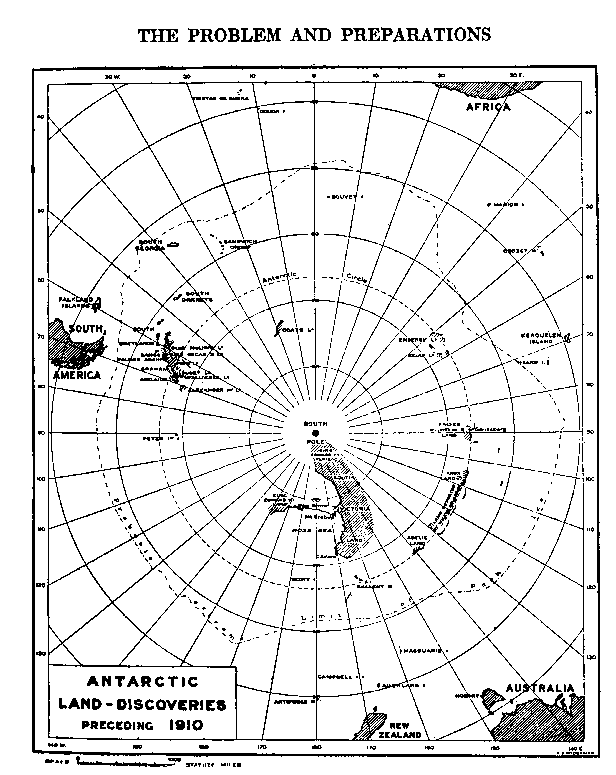
Antarctic Land discoveries preceding
the year 1910
The polar regions, like any other part of the
globe, may be said to be paved with facts, the essence of which
it is necessary to acquire before knowledge of this special
zone can be brought to even a provisional exactitude. On the
face of it, polar research may seem to be specific and discriminating,
but it must be remembered that an advance in any one of the
departments into which, for convenience, science is artificially
divided, conduces to the advantage of all. Science is a homogeneous
whole. If we ignore the facts contained in one part of the world,
surely we are hampering scientific advance. It is obvious to
every one that, given only a fraction of the pieces, it is a
much more difficult task to put together a jig-saw puzzle and
obtain an idea of the finished pattern than were all the pieces
at hand. The pieces of the jig-saw puzzle are the data of
science.
Though it is not sufficiently recognized, the
advance of science is attended by a corresponding increase in
the creature comforts of man. Again, from an economic aspect,
the frozen South may not attract immediate attention. But who
can say what a train of enterprise the future may bring?
Captain James Cook, on his return to London after the circumnavigation
of Antarctica, held that the far-southern lands had no future.
Yet, a few years later, great profits were being returned to
Great Britain and the United States from sealing-stations established
as a result of Cook's own observations. At the present day,
several whaling companies have flourishing industries in the
Antarctic waters within the American Quadrant.
Even now
much can be said in regard to the possibilities offered by the
Antarctic regions for economic development, but, year by year,
the outlook will widen, since man is constantly resorting to
subtler and more ingenious artifice in applying Nature's
resources. It will be remembered that Charles Darwin, when in
Australia, predicted a very limited commercial future for New
South Wales. But the mastery of man overcame the difficulties
which Darwin's too penetrating mind foresaw.
What
will be the role of the South in the progress of civilization
and in the development of the arts and sciences, is not now
obvious. As sure as there is here a vast mass of land with potentialities,
strictly limited at present, so surely will it be cemented some
day within the universal plinth of things.
An unknown
coast-line lay before the door of Australia. Following on the
general advance of exploration, and as a sequel to several important
discoveries, the time arrived when a complete elucidation of
the Antarctic problem was more than ever desirable. In the Australian
Quadrant, the broad geographical features of the Ross Sea area
were well known, but of the remainder and greater portion of
the tract only vague and imperfect reports could be supplied.
Before submitting our plans in outline, it will be as well
to review the stage at which discovery had arrived when our
Expedition came upon the scene.
The coast-line of the
eastern extremity of the Australian Quadrant, including the
outline of the Ross Sea and the coast west-north-west of Cape
Adare as far as Cape North, was charted by Ross and has been
amplified by seven later expeditions. In the region west of
Cape North, recent explorers had done little up till 1911. Scott
in the `Discovery' had disproved the existence of some of
Wilkes's land; Shackleton in the `Nimrod' had viewed
some forty miles of high land beyond Cape North; lastly, on
the eve of our departure, Scott's `Terra
Nova' had
met two patches of new land--Oates Land--still farther west,
making it evident that the continent ranged at least two hundred
and eighty miles in a west-north-west direction from Cape Adare.
Just outside the western limit of the Australian Quadrant
lies Gaussberg, discovered by a German expedition under Drygalski
in 1902. Between the most westerly point sighted by the `Terra
Nova' and Gaussberg, there is a circuit of two thousand
miles, bordering the Antarctic Circle, which no vessel had navigated
previous to 1840.
This was the arena of our activities
and, therefore, a synopsis of the voyages of early mariners
will be enlightening.
Balleny, a whaling-master, with
the schooner `Eliza Scott' of one hundred and fifty-four
tons, and a cutter, the `Sabrina' of fifty-four tons, was
the first to meet with success in these waters. Proceeding southward
from New Zealand in 1839, he located the Balleny Islands, a
group containing active volcanoes, lying about two hundred miles
off the nearest part of the mainland and to the north-west of
Cape Adare. Leaving these islands, Balleny sailed westward keeping
a look-out for new land. During a gale the vessels became separated
and the `Sabrina' was lost with all hands. Balleny in the
`Eliza Scott' arrived safely in England and reported doubtful
land in 122 degrees E. longitude, approximately. Dr. H. R. Mill
says: ``Although the name of the cutter `Sabrina' has been
given to an appearance of land at this point, we cannot look
upon its discovery as proved by the vague reference made by
the explorers.''
On January 1, 1840, Dumont D'Urville
sailed southward from Hobart in command of two corvettes, the
`Astrolabe' and the `Zelee'. Without much obstruction
from floating ice, he came within sight of the Antarctic coast,
thenceforth known as Adelie Land. The expedition did not set
foot on the mainland, but on an adjacent island. They remained
in the vicinity of the coast for a few days, when a gale sprang
up which was hazardously weathered on the windward side of the
pack-ice. The ships then cruised along the face of flat-topped
ice-cliffs, of the type known as barrier-ice or shelf-ice, which
were taken to be connected with land and named Cote Clarie.
As will be seen later, Cote Clarie does not exist.
Dr.
H. R. Mill sums up the work done by the French expedition during
its eleven days' sojourn in the vicinity of the Antarctic
coast:
``D'Urville's discoveries of land were
of but little account. He twice traced out considerable stretches
of a solid barrier of ice, and at one point saw and landed upon
rocks in front of it; but he could only give the vaguest account
of what lay behind the barrier.''
Wilkes of the
American expedition proceeded south from Sydney at the close
of 1839. His vessels were the `Vincennes', a sloop of war
of seven hundred and eighty tons, the `Peacock', another
sloop of six hundred and fifty tons, the `Porpoise', a gun-brig
of two hundred and thirty tons and a tender, the `Flying Fish'
of ninety-six tons. The scientists of the expedition were precluded
from joining in this part of the programme, and were left behind
in Sydney. Wilkes himself was loud in his denunciation both
of the ships and of the stores, though they had been specially
assembled by the naval department. The ships were in Antarctic
waters for a period of forty-two days, most of the time separated
by gales, during which the crews showed great skill in navigating
their ill-fitted crafts and suffered great hardships.
Land was reported almost daily, but, unfortunately, subsequent
exploration has shown that most of the landfalls do not exist.
Several soundings made by Wilkes were indicative of the approach
to land, but he must have frequently mistaken for it distant
ice-masses frozen in the pack. Experience has proved what deceptive
light- effects may be observed amid the ice and how easily a
mirage may simulate reality.
Whatever the cause of Wilkes's
errors, the truth remains that Ross sailed over land indicated
in a rough chart which had been forwarded to him by Wilkes,
just before the British expedition set out. More recently, Captain
Scott in the `Discovery' erased many of the landfalls of
Wilkes, and now we have still further reduced their number.
The `Challenger' approached within fifteen miles of the
western extremity of Wilkes's Termination Land, but saw
no sign of it. The `Gauss' in the same waters charted Kaiser
Wilhelm II Land well to the south of Termination Land, and the
eastward continuation of the former could not have been visible
from Wilkes's ship. After the voyage of the `Discovery',
the landfalls, the existence of which had not been disproved,
might well have been regarded as requiring confirmation before
their validity could be recognised.
The only spot where
rocks were reported in situ was in Adelie Land, where the French
had anticipated the Americans by seven days. Farther west, earth
and stones had been collected by Wilkes from material embedded
in floating masses of ice off the coast of his Knox Land. These
facts lend credence to Wilkes's claims of land in that vicinity.
His expedition did not once set foot on Antarctic shores, and,
possibly on account of the absence of the scientific staff,
his descriptions tend to be inexact and obscure. The soundings
made by Wilkes were sufficient to show that he was probably
in some places at no great distance from the coast, and, considering
that his work was carried out in the days of sailing-ships,
in unsuitable craft, under the most adverse weather conditions,
with crews scurvy-stricken and discontented, it is wonderful
how much was achieved. We may amply testify that he did more
than open the field for future expeditions.
After we
had taken into account the valuable soundings of the `Challenger'
(1872), the above comprised our knowledge concerning some two
thousand miles of prospective coast lying to the southward of
Australia, at a time when the plans of the Australasian expedition
were being formulated.
The original plans for the expedition
were somewhat modified upon my return from Europe. Briefly stated,
it was decided that a party of five men should be stationed
at Macquarie Island, a sub-antarctic possession of the Commonwealth.
They were to be provided with a hut, stores and a complete wireless
plant, and were to prosecute general scientific investigations,
co-operating with the Antarctic bases in meteorological and
other work. After disembarking the party at Macquarie Island,
the `Aurora' was to proceed south on a meridian of 158 degrees
E. longitude, to the westward of which the Antarctic programme
was to be conducted.
Twelve men, provisioned and equipped
for a year's campaign and provided with wireless apparatus,
were to be landed in Antarctica on the first possible opportunity
at what would constitute a main base. Thereafter, proceeding
westward, it was hoped that a second and a third party, consisting
of six and eight men respectively, would be successively established
on the continent at considerable distances apart. Of course
we were well aware of the difficulties of landing even one party,
but, as division of our forces would under normal conditions
secure more scientific data, it was deemed advisable to be prepared
for exceptionally favourable circumstances.
Macquarie
Island, a busy station in the days of the early sealers, had
become almost neglected. Little accurate information was to
be had regarding it, and no reliable map existed. A few isolated
facts had been gathered of its geology, and the anomalous fauna
and flora sui generis had been but partially described. Its
position, eight hundred and fifty miles south-south-east of
Hobart, gave promise of valuable meteorological data relative
to the atmospheric circulation of the Southern Hemisphere and
of vital interest to the shipping of
Australia and New Zealand.
As to the Antarctic sphere of work, it has been seen
that very little was known of the vast region which was our
goal. It is sufficient to say that almost every observation
would be fresh material added to the sum of human knowledge.
In addition to the work to be conducted from the land bases,
it was intended that oceanographic investigations should be
carried on by the `Aurora' as far as funds would allow.
With this object in view, provision was made for the necessary
apparatus which would enable the ship's party to make extensive
investigations of the ocean and its floor over the broad belt
between Australia and the Antarctic Continent. This was an important
branch of study, for science is just as much interested in the
greatest depths of the ocean as with the corresponding elevations
of the land. Indeed, at the present day, the former is perhaps
the greater field.
The scope of our intentions was regarded
by some as over-ambitious, but knowing How far high failure
overleaps the bound Of low successes, and seeing nothing
impossible in these arrangements, we continued to adhere to
them as closely as possible, with what fortune remains to be
told.
To secure a suitable vessel was a matter of fundamental
importance. There was no question of having a ship built to
our design, for the requisite expenditure might well have exceeded
the whole cost of our
Expedition. Accordingly the best obtainable
vessel was purchased, and modified to fulfil our requirements.
Such craft are not to be had in southern waters; they are only
to be found engaged in Arctic whaling and sealing.
The
primary consideration in the design of a vessel built to navigate
amid the ice is that the hull be very staunch, capable of driving
into the pack and of resisting lateral pressure, if the ice
should close in around it.
So a thick-walled timber vessel,
with adequate stiffening in the framework, would meet the case.
The construction being of wood imparts a certain elasticity,
which is of great advantage in easing the shock of impacts with
floating ice. As has been tragically illustrated in a recent
disaster, the ordinary steel ship would be ripped on its first
contact with the ice. Another device, to obviate the shock and
to assist in forging a way through the floe-ice, is to have
the bow cut away below the water-line. Thus, instead of presenting
to the ice a vertical face, which would immediately arrest the
ship and possibly cause considerable damage on account of the
sudden stress of the blow, a sloping, overhanging bow is adopted.
This arrangement enables the bow to rise over the impediment,
with a gradual slackening of speed. The immense weight put upon
the ice crushes it and the ship settles down, moving ahead and
gathering speed to meet the next obstacle.
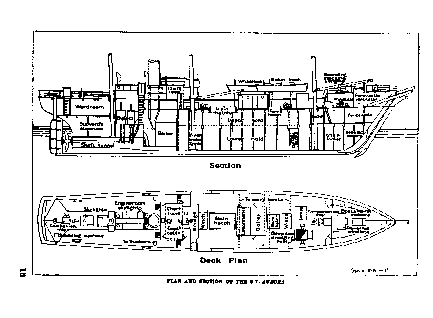
Plan and Section of S.Y. `Aurora'
Of importance second only to a strong hull is
the possession of sails in addition to engines. The latter are
a sine qua non in polar navigation, whilst sails allow of economy
in the consumption of coal, and always remain as a last resort
should the coal-supply be exhausted or the propeller damaged.
The `Aurora', of the Newfoundland sealing fleet, was
ultimately purchased and underwent necessary alterations. She
was built in Dundee in 1876, but though by no means young was
still in good condition and capable of buffeting with the pack
for many a year. Also, she was not without a history, for in
the earlier days she was amongst those vessels which hurried
to the relief of the unfortunate Greely expedition.
The
hull was made of stout oak planks, sheathed with greenheart
and lined with fir. The bow, fashioned on cutaway lines, was
a mass of solid wood, armoured with steel plates. The heavy
side-frames were braced and stiffened by two tiers of horizontal
oak beams, upon which were built the 'tween decks and the
main deck. Three bulkheads isolated the fore-peak, the main
hold, the engine-room and the after living-quarters respectively.
A hull of such strength would resist a heavy strain, and,
should it be subjected to lateral pressure, would in all probability
rise out of harm's way. However, to be quite certain of
this and to ensure safety in the most extreme case it is necessary
that the hull be modelled after the design adopted by Nansen
in the `Fram'.
The principal dimensions were, length
one hundred and sixty-five feet, breadth thirty feet, and depth
eighteen feet.
The registered tonnage was three hundred
and eighty-six, but the actual carrying capacity we found to
be about six hundred tons.
The engines, situated aft,
were compound, supplied with steam from a single boiler. The
normal power registered was ninety-eight horse-power, working
a four-bladed propeller, driving it at the rate of sixty or
seventy revolutions per minute (six to ten knots per hour).
Steam was also laid on to a winch, aft, for handling cargo
in the main hold, and to a forward steam-windlass. The latter
was mainly used for raising the anchor and manipulating the
deep-sea dredging-cable.
The ship was square on the foremast
and schooner-rigged on the main and mizen masts.
Between
the engine-room bulkhead and the chain and sail locker was a
spacious hold. Six large steel tanks built into the bottom of
the hold served for the storage of fresh water and at any time
when empty could be filled with seawater, offering a ready means
of securing emergency ballast.
On the deck, just forward
of the main hatch, was a deckhouse, comprising cook's galley,
steward's pantry and two laboratories. Still farther forward
was a small lamp-room for the storage of kerosene, lamps and
other necessaries. A lofty fo'c'sle-head gave much accommodation
for carpenters', shipwrights' and other stores. Below
it, a capacious fo'c'sle served as quarters for a crew
of sixteen men.
Aft, the chart-room, captain's cabin
and photographic dark-room formed a block leading up to the
bridge, situated immediately in front of the funnel. Farther
aft, behind the engine-room and below the poop deck, was the
ward-room(,) a central space sixteen feet by eight feet, filled
by the dining-table and surrounded by cabins with bunks for
twenty persons.
From the time the `Aurora' arrived
in London to her departure from Australia, she was a scene of
busy activity, as alterations and replacements were necessary
to fit her for future work.
In the meantime, stores and
gear were being assembled. Purchases were made and valuable
donations received both in Europe and Australia. Many and varied
were the requirements, and some idea of their great multiplicity
will be gained by referring to the appendices dealing with stores,
clothing and instruments.
Finally, reference may be made
in this chapter to the staff. In no department can a leader
spend time more profitably than in the selection of the men
who are to accomplish the work. Even when the expedition has
a scientific basis, academic distinction becomes secondary in
the choice of men. Fiala, as a result of his Arctic experience,
truly says, ``Many a man who is a jolly good fellow in congenial
surroundings will become impatient, selfish and mean when obliged
to sacrifice his comfort, curb his desires and work hard in
what seems a losing fight. The first consideration in the choice
of men for a polar campaign should be the moral quality. Next
should come mental and physical powers.''
For
polar work the great desideratum is tempered youth. Although
one man at the age of fifty may be as strong physically as another
at the age of twenty, it is certain that the exceptional man
of fifty was also an exceptional man at twenty. On the average,
after about thirty years of age, the elasticity of the body
to rise to the strain of emergency diminishes, and, when forty
years is reached, a man, medically speaking, reaches his acme.
After that, degeneration of the fabric of the body slowly and
maybe imperceptibly sets in. As the difficulties of exploration
in cold regions approximate to the limit of human endurance
and often enough exceed it, it is obvious that the above generalizations
must receive due weight.
But though age and with it the
whole question of physical fitness must ever receive primary
regard, yet these alone in no wise fit a man for such an undertaking.
The qualifications of mental ability, acquaintance with the
work and sound moral quality have to be essentially borne in
mind. The man of fifty might then be placed on a higher plane
than his younger companion.
With regard to alcohol and
tobacco, it may be maintained on theoretical grounds that a
man is better without them, but, on the other hand, his behaviour
in respect to such habits is often an index to his self-control.
Perfection is attained when every man individually works
with the determination to sacrifice all personal predispositions
to the welfare of the whole.
Ours proved to be a very
happy selection. The majority of the men chosen as members of
the land parties were young graduates of the Commonwealth and
New Zealand Universities, and almost all were representative
of Australasia. Among the exceptions was Mr. Frank Wild, who
was appointed leader of one of the Antarctic parties. Wild had
distinguished himself in the South on two previous occasions,
and now is in the unique position of being, as it were, the
oldest resident of Antarctica. Our sojourn together at Cape
Royds with Shackleton had acquainted me with Wild's high
merits as an explorer and leader.
Lieutenant B. E. S.
Ninnis of the Royal Fusiliers, Dr. X. Mertz, an expert ski-runner
and mountaineer, and Mr. F. H. Bickerton in charge of the air-tractor
sledge, were appointed in London. Reference has already been
made to Captain Davis: to him were left all arrangements regarding
the ship's complement.
A ``Who's who''
of the staff appears as an appendix.
CHAPTER II - THE LAST DAYS AT HOBART AND THE VOYAGE TO MACQUARIE ISLAND