
Antarctic History
A Time Line of the Exploration of Antarctica
A
Brief History of the
Exploration of Antarctica
350 B.C.
It was the ancient Greeks who first came up with the idea of Antarctica. They knew about the Arctic - named Arktos -The Bear, from the constellation the great bear and decided that in order to balance the world, there should be a similar cold Southern landmass that was the same but the opposite "Ant - Arktos" - opposite The Bear. They never actually went there, it was just a lucky guess!

1773
In January, Captain James Cook crosses the Antarctic circle and circumnavigates Antarctica, though he doesn't sight land, deposits of rock seen in icebergs showed that a southern continent exists. His comment - "I make bold to declare that the world will derive no benefit from it".
1819 - 21
 Captain
Thaddeus Bellingshausen a Russian naval
officer in the Vostok and Mirny circumnavigates the
Antarctic, first to cross the Antarctic circle since
Cook.
Captain
Thaddeus Bellingshausen a Russian naval
officer in the Vostok and Mirny circumnavigates the
Antarctic, first to cross the Antarctic circle since
Cook.
He made the first sighting of the continent, reaching 69° 21'S, 2° 14'W - describing an "icefield covered with small hillocks." on Jan 28th 1820.
For some considerable time, exactly who and when first set eyes on Antarctica were in dispute as British naval officers, William Smith and Edward Bransfield also saw Antarctica on Jan 30th the same year - followed by American sealer Nathaniel Palmer on Nov 16th.
This was the first time a continent had truly been "discovered" (i.e. there weren't any native peoples living there who'd known about it for ages already).
1821
 February the 7th. 1st known landing on continental
Antarctica by American sealer
Captain John Davis,
though this is not acknowledged by all historians.
February the 7th. 1st known landing on continental
Antarctica by American sealer
Captain John Davis,
though this is not acknowledged by all historians.
In the winter of 1821, for the first time ever a party of men spent a winter in Antarctica. An officer and ten men from a British sealing ship the Lord Melville had to spend the winter on King George Island -part of the South Shetlands group, north of the Antarctic Peninsula. The ship had been driven offshore and did not return to pick them up again. They were rescued the following summer.
1823
 British
whaler James Weddell
discovers the sea named after him and then reaches the
most southerly point at that time 74° 15' S. No one
else manages to penetrate the Weddell sea again for
80 years.
British
whaler James Weddell
discovers the sea named after him and then reaches the
most southerly point at that time 74° 15' S. No one
else manages to penetrate the Weddell sea again for
80 years.
Separate British, French and American expeditions establish the status of Antarctica as a continent after sailing along continuous coastline.
In 1840, British naval officer and scientist James Clark Ross takes two ships, the Erebus and the Terror, to within 80 miles of the coast until stopped by a massive ice barrier - now called the Ross Ice Shelf. He also discovers the active volcano that he names after his ship Erebus, and identifies 145 new species of fish (not personally you understand - a scientist on the ship did that bit).
Late 1800's
to early 20th century
Many expeditions largely by sealers and whalers to all parts of Antarctica.Mainly marine exploration and exploration of the sub Antarctic islands.
1898
March. Adrien de Gerlache and the crew of the "Belgica" become trapped in pack ice off the Antarctic Peninsula in the first scientific expedition to the continent. They become the first to survive an Antarctic winter (involuntarily!) as their ship drifts with the ice (they didn't enjoy it).
1899Carsten Borchgrevink leads a British expedition that landed men at Cape Adare and built huts. This was the first time that anyone had wintered on the Antarctic landmass. Believed by some historians to be the first confirmed landing on continental Antarctica.
1901Captain Scott, UK, leads his first Antarctic expedition to try to reach the South Pole, with Ernest Shackleton and Edward Wilson. They are forced to turn back two months later having reached 82 degrees south, suffering from snow blindness and scurvy.
Several
other publicly and privately sponsored expeditions
around this time.
By now, these
are driven by science, geography and exploration-
less by the exploitation of resources such as seals
and whales.
1907 - 1909
Ernest Shackleton leads expedition to within 156km / 97mls of the South Pole, turns back after supplies are exhausted.
1909
January, Australian
Douglas Mawson reaches the South
Magnetic Pole.
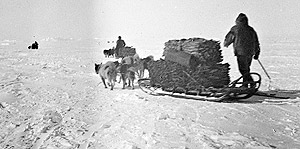
December 14th. Norwegian Roald Amundsen leads a five man expedition that reaches the South Pole for the first time.
1912
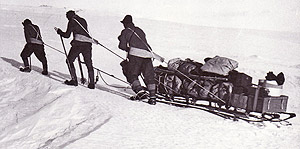
December.
Douglas Mawson
begins his trek across George V Land back to his base
at Commonwealth Bay. His two companions had died, and
against the odds he makes it home. A new section of
coast is discovered and described, and radio is used
for the first time in Antarctica.
October. Ernest Shackleton returns to Antarctica in an attempt to complete the first crossing of the continent. The goal is not attained, but one of the greatest adventures of all time follows. Their ship is crushed in the sea ice and a small party sets out for South Georgia and the whaling station. The party is eventually rescued in 1917.
1923The beginning of large-scale factory ship whaling in the Ross Sea.
 1928
1928Australian Sir Hubert Wilkins and American Carl Benjamin Eielson are the first to fly over Antarctica around the peninsula region.
1929Richard E. Byrd and three others - US - become the first to fly over the South Pole.
1935Lincoln Ellsworth - US - flies across the continent.
Caroline Mikkelsen, Norway, is the first woman to set foot on Antarctica when she accompanies her husband, a whaling captain.
1947Operation Highjump - US- sends the largest ever expedition of over 4700 men, 13 ships and 23 airplanes to Antarctica. Most of the coast is photographed for map making.
1956US aircraft lands at South Pole. First people there since Scott and his team in 1912.
 1st
July 1957 - 31st Dec 1958
1st
July 1957 - 31st Dec 1958International Geophysical Year (IGY) 12 nations establish over 60 stations in Antarctica. The beginning of international cooperation in Antarctica and the start of the process by which Antarctica becomes "non-national".
The first successful land crossing via the South Pole is led by British geologist Vivian Fuchs with New Zealander Edmund Hillary leading the back up party, over 40 years after Shackleton's expedition set out with the same aim.
 1961
1961Antarctic treaty comes into effect. An agreement initially amongst twelve nations to use Antarctica for peaceful purposes only and suspend territorial claims, by 2019 there are 54 signatories.
1997
Boerge Ousland (Norway) becomes first person to cross Antarctica unsupported. Taking 64 days from Berkner Island to Scott base towing a 180kg (400lb) sled and using skis and a sail.
March 2007 - March 2009International Polar Year - Actually Spans two years in order that researchers get the opportunity to work in both polar regions or work summer and winter if they wish.
What Else was Happening in the World?
1776 - USA becomes independent from Great Britain
1780 - James Watt perfects the steam engine
1815 - Battle of Waterloo
1830 - World's first railway opens
1840 - Victoria becomes queen of Great Britain
1859 - Darwin publishes "Origin of Species"
1867 - Canada becomes an independent nation
1885 - Karl Benz builds the first motor car
1896 - Marconi invents wireless telegraph (radio)
1901 - Australia becomes an independent nation.
Queen Victoria dies. End of the Victorian era.
President McKinley shot, USA. Roosevelt takes over
1903 - Wright brothers make the first powered flight of an airplane
Marie Curie becomes first woman to win a Nobel prize
1908 - Ford motor company produce the "Model T"
1912 - Titanic sinks on maiden voyage killing 1500 people
1914-1918
World War I
1919 - Professor Ernest Rutherford splits the atom
1927 - Al Jolson stars in the "Jazz Singer" the first talkie film
1930's - Great depression era
1939 - 1945
World War II
1947 - Picard invents the bathyscaphe and descends to 4000m in the ocean
1953 - Edmund Hilary and Sherpa Tensing climb Mount Everest for the first time
1969 - Men first walk on the moon
Other Stuff
Lets pretend to be Ancient Greeks

Perform a thought experiment like the ancient scientists and philosophers.
If the logic is sound and argument convincing, it could be taken as the "Truth". The landmasses on Earth have been pretty much sorted out, so how about another planet - say Venus.
Can't see the surface - too cloudy
No contact ever, no radio waves- very primitive.
Closer to sun than us - hot and sweaty.
Similar (ish) to Earth ages ago. Humid - probably rainforests every where, very ancient
= Dinosaurs,
Bingo!
Observation - we can't see anything.
Conclusion - Dinosaurs live there!
But hey, it's convincing and that's probably good enough. This idea of dinosaurs on Venus was "common knowledge" in the 1800's!
Sealers Finger - The Seals Revenge!

Seals mouths are full of a very rich and varied fauna of exotic bacteria (as a friend of mine, an old Antarctic hand, would describe it they're "goppin").
While trying to kill seals, sealers would often get bitten (hurrah!) and frequently on the fingers. The result would be a very nasty and painful infection as the finger went septic, followed by the loss of the use of that finger. It would still be there but completely immobile - known as "Sealers Finger".
Wrap up warm

Today's scientists and explorers have the benefits of modern fabrics and materials to help keep warm, windproof and dry. These materials are comfortable and lightweight and make conditions much better than in the early days.
Early Antarctic explorers had to make do with heavy layers of itchy woolen fabrics and outer layers that would soak up the moisture produced by sweat. Getting dressed in the morning would often involve putting on layers that were frozen solid with ice in the fabric. As the garments gradually warmed up, they would become more flexible.
The same would happen to pretty much any clothing that was taken off before bed.
Eat well

Early explorers weren't as knowledgeable about nutrition in cold climates either (they learned much that we know today by finding out the hard way). Humans get through much more food in a cold climate, burning it up and converting it to heat rather than energy for physical activity.
Early explorers therefore often went out relatively under stocked with food. This had a limiting effect on the achievements of the earliest expeditions. High energy combined with low weight is the best sort of food for expeditions in cold climates. This usually meant a diet high in fat.
Early expeditions also went out with their food largely tinned or dried, this meant that it was low in vitamins that are destroyed by the canning process. Scurvy caused by a deficiency of vitamin C was therefore a very real problem.

1898 - 1922 is known as the
"Heroic Age" of Antarctic exploration.
The saying among old Antarctic hands was;
"For scientific discovery give me Scott, for
speed and efficiency of travel give me Amundsen,
but when you back's against the wall and there's
no hope left, get down on your knees and pray for
Shackleton".
Divide your food the Antarctic explorers way

Emotions about food on sledging expeditions frequently became almost obsessive. The traditional way of sharing out the often meagre rations was for the days appointed cook to divide the days food into as many equal portions as there were people as fairly as he could. One of the party would then turn his back, the cook would point to a portion and ask "whose?" The man who's turn it was would give the name of who would have that portion. This was done to avoid arguing about who received the largest meal. There were still sometimes complaints though that the cook and the person naming the meals had some kind of secret system organized between them.
Crumbs also became important. When sledging biscuits were broken up, it was done over something that would catch the falling crumbs so that nothing went to waste. The crumbs too were divided up fairly.
After the Heroes
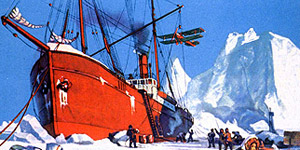
What is called the Heroic Age of Antarctic exploration ended in 1922 with the death of Ernest Shackleton.
The main routes to Antarctica had been found and the South Pole had been reached. Aircraft became used increasingly along with steel hulled ice-strengthened ships with more powerful engines capable of pushing through sea ice with less danger of being trapped. Radio was developed and became more reliable.
No longer did people need to risk sailing to Antarctica in small wooden ships, not really knowing where they were or what was ahead of them and with the best chance of rescue in case of disaster being "If I'm not back next year, please come and look for me the year after".
The risk of enforced winters spent in cramped conditions in an inadequate hut, ice-cave or under an upturned boat, half-starving and eating what passing penguins or seals that can be caugth became a thing of the past.
Permanent research stations were built which were manned by a mixture of scientists and support workers who were changed over every year or two allowing long-term experiments and environmental monitoring to take place.
More was learnt about how to survive in Antarctica and accidents and deaths became rarer.
Today people going to Antarctica are trained in advance of arrival and then receive further training once there on how to deal with the risks and threats from the environment. While the weather still changes plans from time to time, it is possible to plan and carry out ever-more complicated travel and research programmes and expect them to mainly go exactly as planned.
Antarctica has even become a place to safely go for a holiday cruise, as a passenger on a liner, or in a small sailing boat.