
British Antarctic Expedition 1910-13
2 - The Journey
To The South Pole
Captain Robert
Falcon Scott
Terra Nova Expedition: The pole - p.1 - Preparations | The pole p.2 - Journey | The wider Terra Nova expedition | Time-line and info graphic | Crew of the Terra Nova | What went wrong for Scott to die? | What did Scott's team die of? | Race to the pole Amundsen and Scott | The Northern Party
British Antarctic Expedition 1910-13
Had we lived, I should have a tale to tell of the hardihood,
endurance and courage of my companions which would have stirred
the heart of every Englishman. These rough notes and our dead
bodies must tell the tale.
Robert Falcon Scott, March
29th 1912
The Journey to the Pole
Over a period of twelve days in the Antarctic spring of 1911 from the 24th of October to the 4th of November, a team of sixteen men, twenty three dogs, ten ponies, thirteen sledges and two motor sledges set off with Scott to enable a party of four to be the first to reach the South Pole. Most of the team were there to help transport more food and provisions to enable the polar party to make the last leg and return without further help. Those not going to the pole turned back at different points over the first two months..
The slowest, the motor sledges left on the 24th of October, the ponies on the 1st of November and dog teams on the 4th of November. Depots of food and supplies had already been laid along the route before the winter.
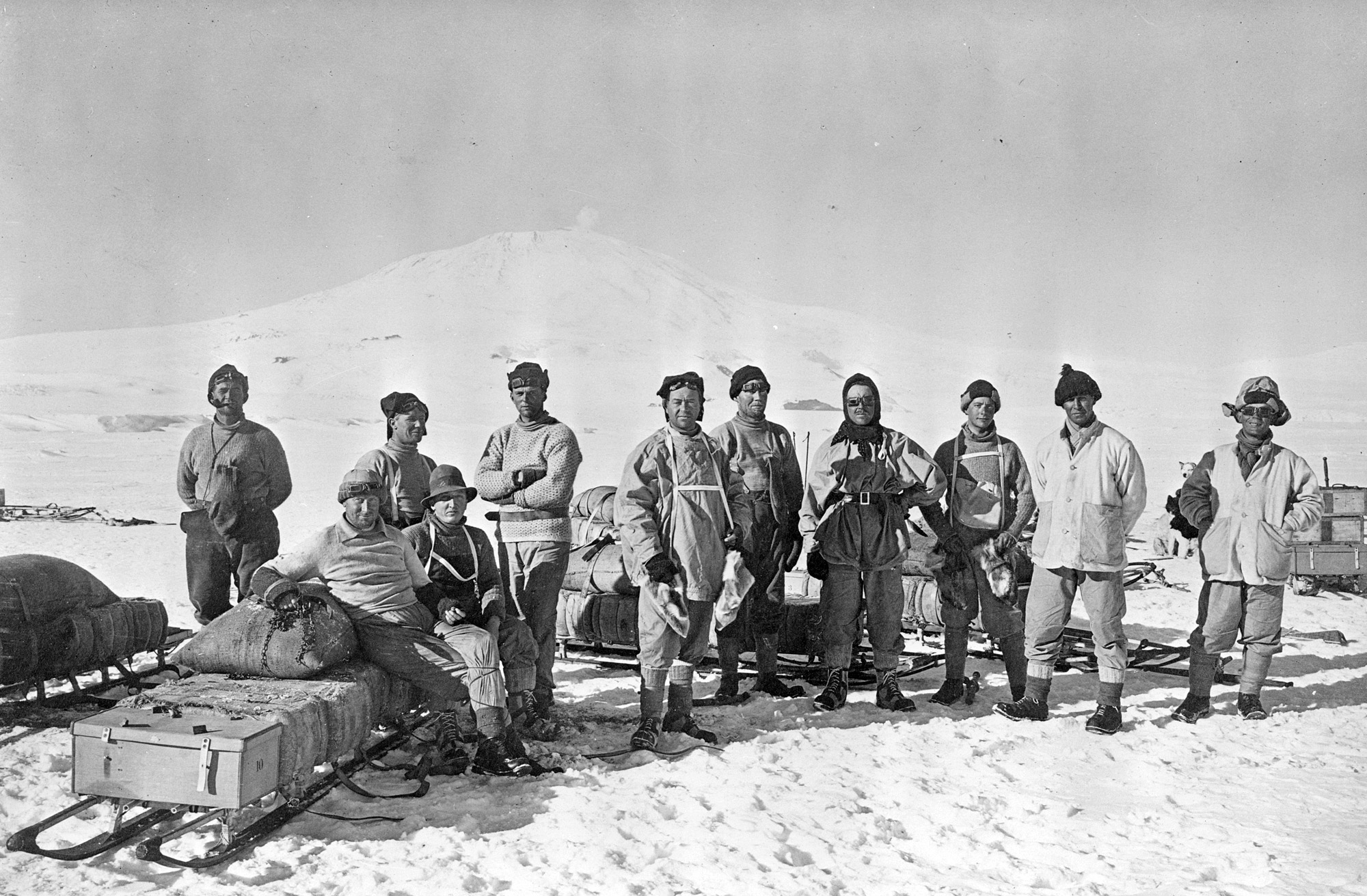
A depot laying party in advance of the attempt
on the pole in front of Mount Erebus, eleven men set off to
manhaul and set depots of stores to be used on the way back
from the pole by the five men that made the last push to the
pole. Jan 26th 1911
The distance from the winter quarters at Hut Point to the Pole and back was 1766 statute miles (further than Land's End to John O'Groats and back again, (or from New York City to Wyoming, Chicago or Denver). Every step of the way had to be marched on foot, with or without skis.
They travelled by night for the benefit of the ponies, and as this was the austral summer, they had 24 hour daylight. Temperatures never rose above zero Fahrenheit (-18°C). Fighting constant snowfalls, the team reached a food and supplies depot called One Ton Camp they had laid the previous summer on the fifteenth day. There was a constant worry that the ponies would not be able to keep going and upon reaching Camp 20 on November 24th, the first pony was killed. Four camps later, on December 1st, the second pony was shot. Depots were made at regular intervals of roughly seventy miles, each containing food and fuel for a week for the returning parties.
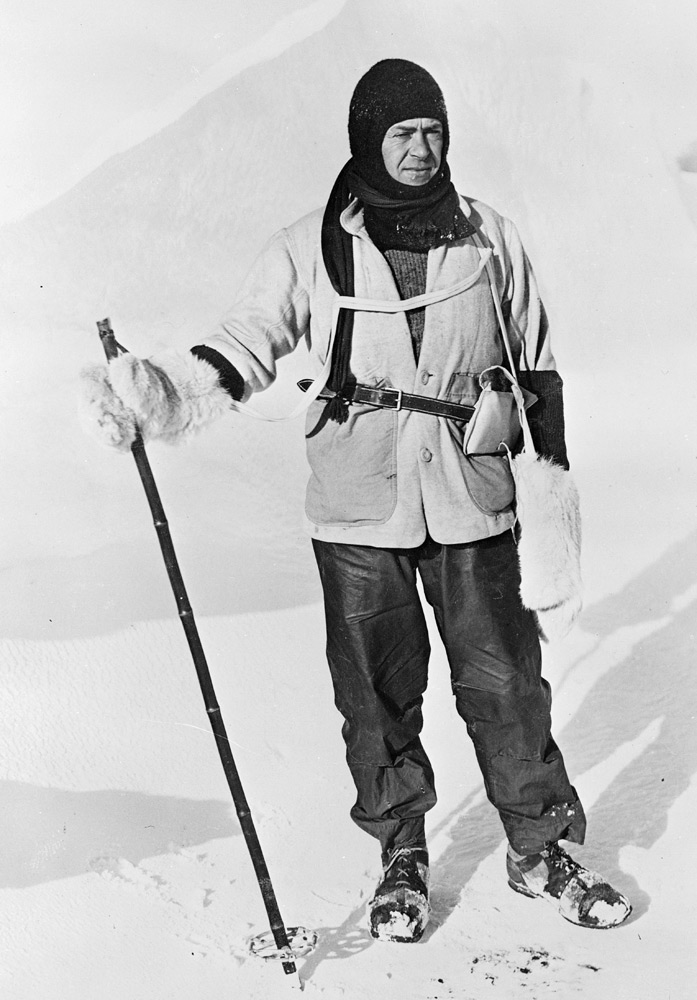 Robert
Falcon Scott
Robert
Falcon Scott
The weather that season was particularly bad, extreme cold interspersed with warmer than usual blizzards that melted the snow and made everything wet and travelling impossible. The ponies continued to have a difficult time of it sinking to the level of their bellies in the soft snow and becoming totally exhausted, they were shot and left behind as depoted food, leaving the remainder of the travelling to manhauling.
Each of the party then began by pulling around 200 pounds through soft snow into which they sank into nearly up to their knees. They were affected by snow-blindness and sometimes stumbled into crevasses, sledges and all. On December 13th, the day before Amundsen reached the Pole, the party had advanced less than four miles in nine hours. On December 20th Scott named the first returning party of four. Scott had dreaded this moment as all had pulled to the limit of their strength, but this four were now to be deprived of their reward, attainment of the South Pole. They reached "home" at Hut point 35 days later on January 26th.
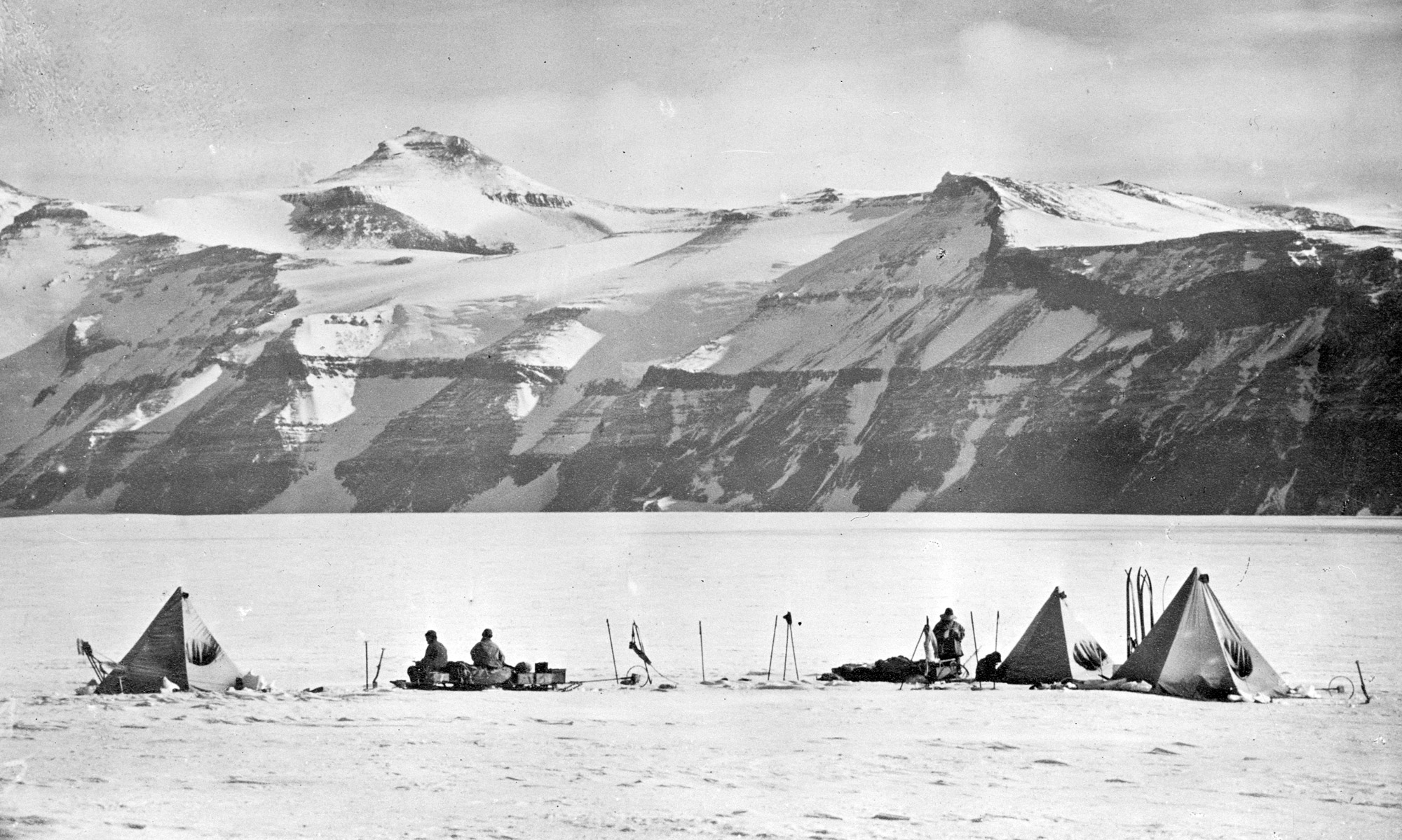
A camp on the Beardmore Glacier
The remaining men made good progress and soon the time came for Scott to make his second difficult announcement that a further three men were to return to Hut point leaving the final party of five (originally to be four, but increased to five at the last moment with the addition of Bowers) to continue to the pole. The two parties separated on January 3rd at 87°32'S, at an altitude of 10,280 feet on the high polar plateau, 169 miles from the Pole.
Scott and the others followed Shackleton's route from 1909, on January 6th they crossed the line of latitude where Shackleton turned back and were further south, 88°23'S than any man had been before or so they believed. They were now 97 miles from the pole, but it took them ten days to cover this due to the weather conditions and state of the snow and ice they were pulling their sledges across.
The men were growing very tired by this point, progress was often made of only five, six or seven miles a day. Each day was a hard grind and was taking a dreadful toll. On January 16th they made good progress and thought that they would reach the Pole the following day. In the afternoon of that day, Bowers spotted something ahead which looked like a cairn. Half an hour later they realized the black speck was a flag tied to a sledge bearer. Nearby was the remains of a camp along with tracks made by sledges and dogs, it was not yet the Pole however.
"This told us the whole story. The Norwegians
have forestalled us and are first at the Pole. It is a terrible
disappointment and I am very sorry for my loyal companions.
Many thoughts come and much discussion we have had. To-morrow
we must march on the Pole, and then hasten home with all
the speed we can compass. All the day-dreams must go; it
will be a wearisome return".
- Scott
January the 17th was "....a horrible day..." , a strong headwind and temperatures of -30°C giving three of them frostbite. Scott's journal records "Great God! This is an awful place and terrible enough for us to have laboured to it without the reward of priority".
They reached the pole on January 17th 1912 to find a small tent supported by a single bamboo flying a Norwegian flag. Inside was a record of the five who had been the first to reach the pole;
Roald Amundsen
Olav Olavson
Bjaaland
Hilmer Hanssen
Sverre H. Hassel
Oscar Wisting
There was also a letter to be delivered to King Haakon of Norway.
"We built a cairn, put up our poor slighted
Union Jack, and photographed ourselves - mighty cold work
all of it....."
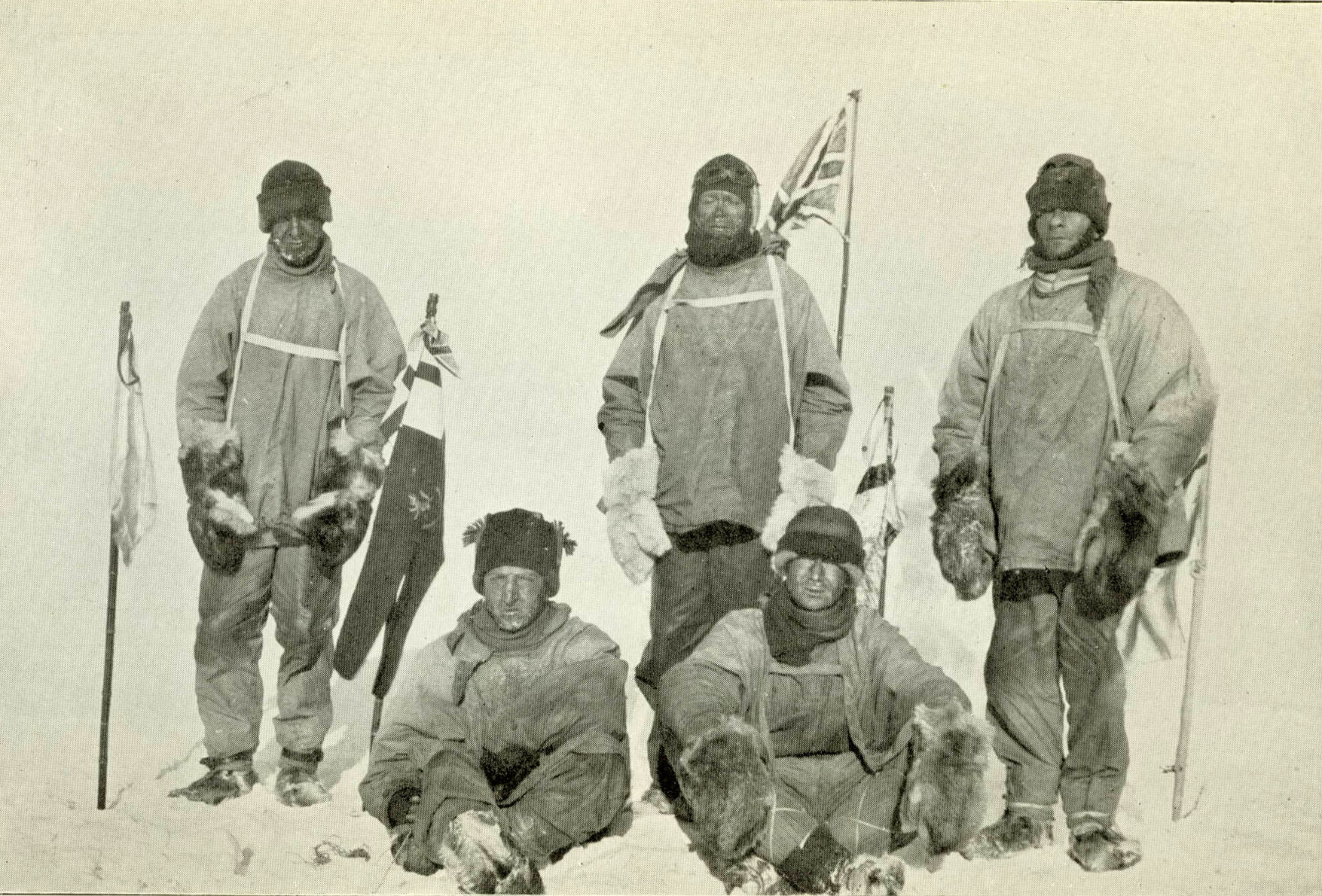
The South Pole party from left
to right - Oates, Bowers, Scott, Wilson, Evans. They reached
the Pole on the 17th of January 1912.
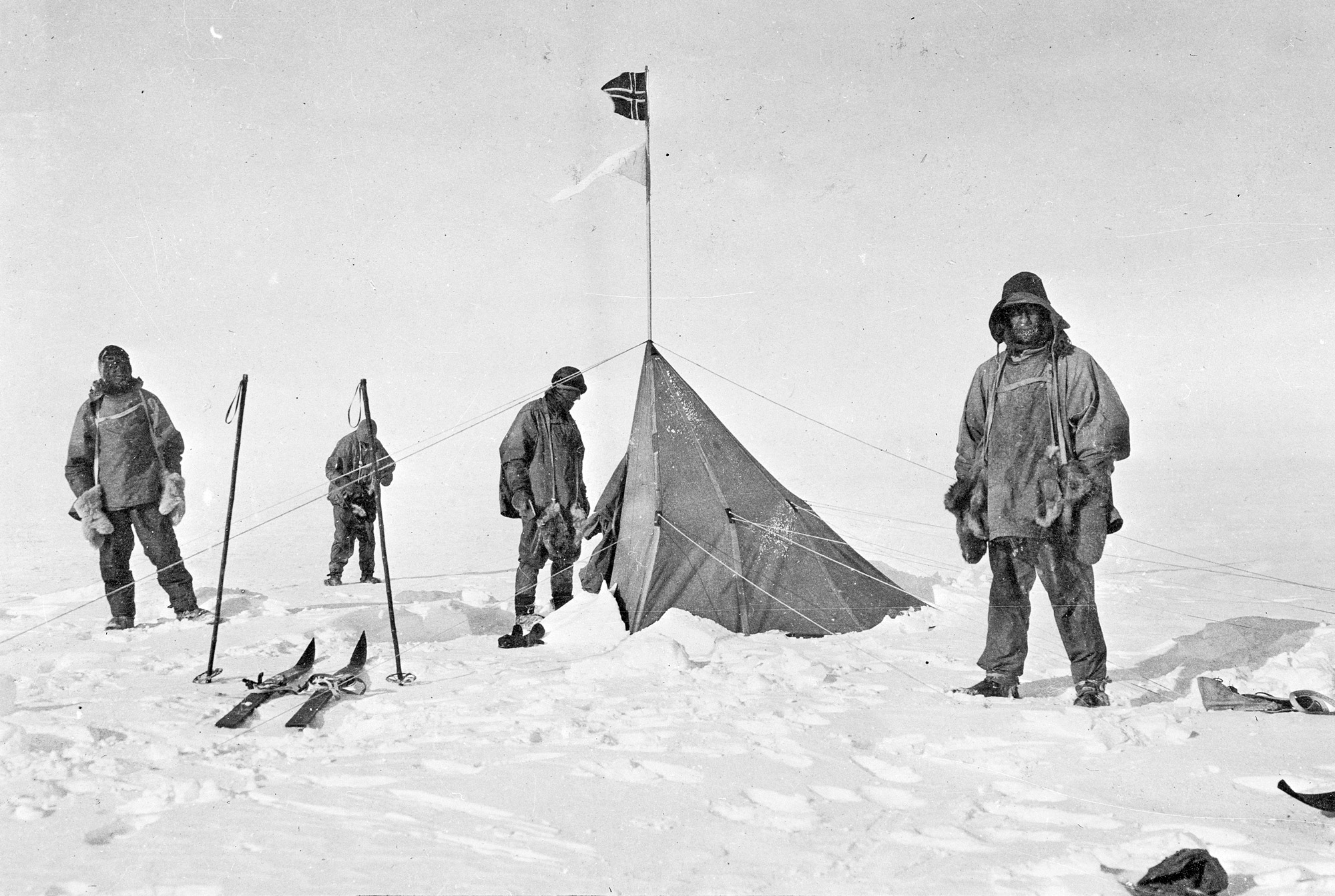
Scott's Polar party at Amundsen's
tent and marker flag, January 18th 1912, about a month
after Amundsen's party had reached the Pole on the 14th
of December 1911.
The return trip started out fairly well but the weather would become more severe and there was no incentive of being the first to reach the pole to cheer them and spur them onwards. Scott wrote on the 21st of January 1912 "Oates is feeling the cold and fatigue more than most of us" and on the 23rd of January "Wilson suddenly discovered Evans nose was frostbitten - it was white and hard. There is no doubt that Evans is a good deal run down".
By the 24th of January the first note of serious
apprehension entered into Scott's diary entries:
"This is the second full gale since we left
the pole. I don't like the look of it. Is the weather
breaking up? If so God help us, with the tremendous journey
and scanty food".
The men were becoming tired now and injuries were increasing, they didn't know it but they had been undernourished for several weeks, Wilson suffered snow-blindness, Oates had frostbitten feet. Frostbite also affected Evans' fingers and nose. They had many falls, Scott damaging his shoulder in one. Evans had a bad fall on the 4th of February suffering concussion - he was never to really recover.
They became lost at one point while descending the Beardmore glacier and had a nightmarish two days in badly crevassed and broken ice not knowing in which direction to head and becoming more despondent. They were down to their last meal and unable to find the food depot until at the last they did so. "It was an immense relief and we were soon in possession of our three and a half days food. The relief to all is inexpressible.......... Yesterday was the worst experience of the trip and gave a horrid feeling of insecurity".
February 16th - "Evans has nearly broken down in brain, we think". The next day he started reasonably well but soon left his sledge traces to walk alongside. He fell further and further back and was soon out of sight. By lunchtime the others went back to find him. He was on his knees, clothing disarranged, hands uncovered and frostbitten and with a "wild look in his eyes" (some of the classic signs of hypothermia). He was placed onto a sledge and taken to the camp they had set up, he was comatose by the time he was placed in the tent. He died quietly at 12.30 a.m.
The weather continued to be against them, particularly intense cold down to -40°C and the surface bad for hauling a sledge over beyond their worst fears. On March 5th Scott records "Oates' feet are in a wretched condition... The poor soldier is very nearly done." Despite the cold and awful surfaces Oates kept going attended to by Wilson the doctor, but on March the 16th he proposed that his companions leave him in his sleeping bag and continue themselves. A request they could not grant and induced him to join the afternoon march when they made a few extra miles. He was worse that night and went to sleep hoping not to wake, he did wake however to find a blizzard blowing. His now famous last words were "I am just going outside and may be some time." He walked out to his death so that he would no longer be a burden to his friends who themselves were in worsening physical condition. His feet had been so bad and the process of putting his boots on so painful that he didn't go through this torture and walked out to his death in his socks.
"We knew that poor Oates was walking to
his death, but though we tried to dissuade him, we knew
it was the act of a brave man and an English gentleman.
We all hope to meet the end with a similar spirit and assuredly
the end is not far."
The last camp was made on March 19th only 11 miles from the next depot. They woke on the 20th to another raging blizzard. Scott was suffering badly from a frostbitten foot and Wilson and Bowers were to go to the depot for fuel. By the 22nd they still had not been able to set off, the blizzard was as bad as ever. They never left this final camp having run out of food and fuel, eventually being too weak, cold and hungry to attempt the march. On the 29th of March 1912 Scott made his last diary entry;
"Since the 21st we have had a continuous gale from W.S.W. and S.W. We had fuel to make two cups of tea apiece and bare food for two days on the 20th. Every day we have been ready to start for our depot 11 miles away, but outside the door of the tent it remains a scene of whirling drift. I do not think we can hope for better things now. We shall stick it out to the end, but we are getting weaker of course, and the end cannot be far.
It seems a pity but I do not think I can write more."
The tent and the three frozen bodies were not discovered until nearly 8 months later on November 12th that year. A great cairn of ice was raised over their bodies surmounted by a cross made from skis, a sledge was stood on one end in a smaller cairn nearby.
A search was made for Captain Oates' body, but it was never found, only his discarded sleeping bag, cut open for much of the length to enable him to enter it with badly frostbitten feet.
A cairn was placed at the scene of the search with a note that began "Hereabouts died a very gallant gentleman...."
Later at hut point a cross was erected to the memory of :
Lieutenant
H. R. Bowers
Petty officer Edgar "Taff" Evans
Captain L. E. G. Oates
Captain R. F. Scott
Dr. E. A. Wilson
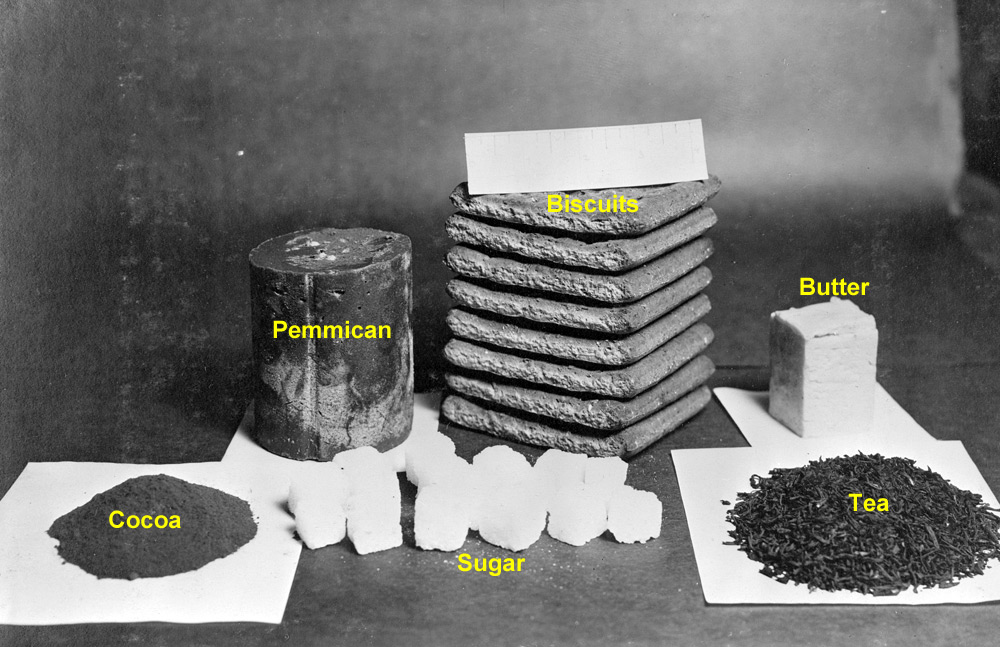 Rations
for one man for one day while manhauling, we now know
this is insufficient food for the conditions and work rate.
The energy requirement for manhauling is now known to be 6500
calories per day, the food ration in the picture supplied around
4600 calories per day. Scott and his men were effectively on
a starvation diet that didn't fulfill their needs leading
to a loss of weight and condition which contributed to their
suffering and loss
Rations
for one man for one day while manhauling, we now know
this is insufficient food for the conditions and work rate.
The energy requirement for manhauling is now known to be 6500
calories per day, the food ration in the picture supplied around
4600 calories per day. Scott and his men were effectively on
a starvation diet that didn't fulfill their needs leading
to a loss of weight and condition which contributed to their
suffering and loss
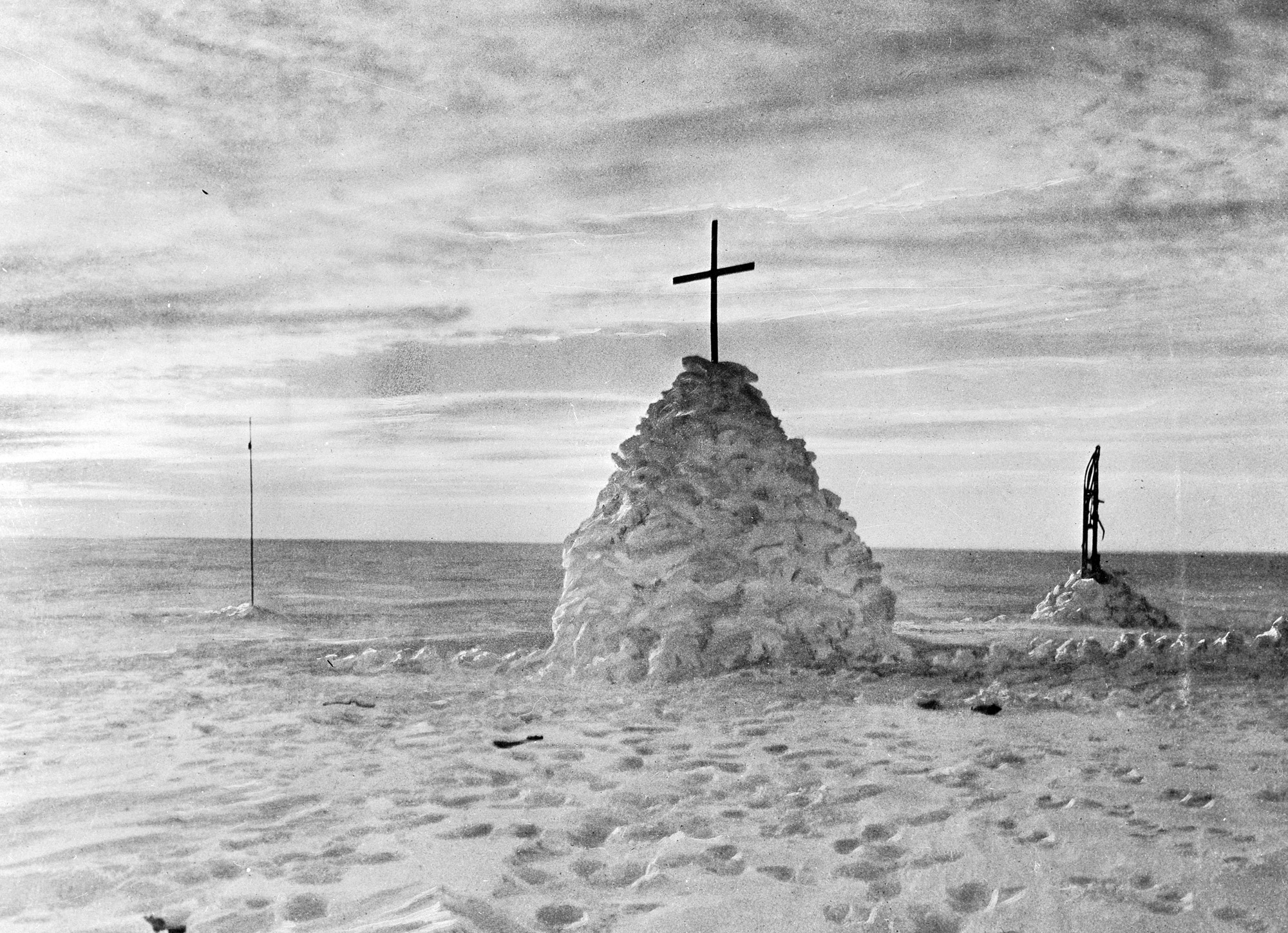
Cairn marking the site of the final campsite
where Bowers, Scott and Wilson died. Scott is thought
to have been the last to die on March 29th 1912, the tent and
bodies within were not found until the 12th of November later
that year. It was eleven miles short of "one tin depot"
where the food and fuel there would have probably ensured the
men's survival.
Memorial service, 14th February 1913, St.Paul's Cathedral, London, video 1 min 18 sces.
Some of the Crew of the Terra Nova Expedition
Abbot, George Percy - 12N -
Petty Officer, R.N.
Atkinson,
Edward L. - 12DPS - R.N. - surgeon, parasitologist
Balson,
Albert - 12 - Leading seaman, R.N.
Bowers, Henry Robertson - 1DCPo
- Lieutenant
Browning, Frank Vernon - 12N
- Petty Officer
Campbell, Victor - 12N - Lieutenant,
R.N.
Cheetham, Alfred B. - Boatswain
(Bosun), R.N.R.
Cherry-Garrard, Apsley - 12DCS
- Assistant zoologist
Crean,
Tom - 12DPS - petty officer, R.N.
Debenham,
Frank - 12iWiiW - Geologist
Dickason,
Harry - 12N - Able Seaman
Evans,
Edgar - 1iWPo
- petty officer, R.N.
Evans, Edward R.G.R. - 1DP - Lieutenant,
R.N. "Teddy Evans" - second in command,
and Captain of the Terra Nova
Girev
(Geroff), Dmitriy - 12DPS - Dog driver
Gran, Tryggve - 12DiiWS - ski expert
Lashly,
William - 12PS - chief stoker, R.N.
Levick,
G. Murray - 12N - Surgeon, R.N.
McLeod,
Thomas F. - 12 - Able seaman
Meares,
Cecil H. - 1DP - in charge of dogs
Oates,
Lawrence - 1DPo
- Capt. 6th Iniskilling Dragoons
Ponting, Herbert G. - 1 - Camera artist
Priestley,
Raymond E. - 12N - Geologist
Omelchenko,
Anton - 1 - Groom
Scott,
Robert Falcon - 1DPo
- Commander, R.N. -
Expedition leader
Simpson,
George - 1 - Meteorologist
Taylor,
T. Griffith - 1iWiiW - Geologist
Wilson,
Edward Adrian - 1DCPo
- chief of scientific staff and biologist
Wright,
Charles Seymour - 12iWPS - Physicist
Key:
1 - first winter
2 - second winter
iW - first western party
iiW - second western party
N - northern party
D - depot laying for south pole journey
P
- south pole party
C - winter journey to Cape
Crozier
S - search party for south Pole party
Po - reached South Pole
Pictures from "Photographs relating to Antarctica and mountaineering. Alexander Turnbull Library, Wellington, New Zealand. http://natlib.govt.nz
Robert Falcon Scott Books and Video

The Coldest March: Scott's Fatal Antarctic Expedition
by Susan Solomon
The Worst Journey in the World. Apsley Cherry-Garrard
The Voyage of the Discovery: Scott's First Antarctic Expedition
by Robert Falcon Scott, Ross MacPhee (Introduction), Fridtjof Nansen (Preface)

The Great White South: Travelling with Robert F. Scott's Doomed
South Pole Expedition by Herbert Ponting
Scott's Last Expedition: The Journals of Captain R.F.Scott

Edward Wilson's Antarctic Notebooks
With Scott to the Pole
Herbert Ponting, illustrated

Discovery Illustrated: Pictures from Captain Scott's First Antarctic Expedition

Captain Scott by Sir Ranulph Fiennes

90 Degrees South: With Scott to the Antarctic (1933) DVD
History Chapters: Roald Amundsen and Robert Scott Race to the South Pole. Ages 4-8

Diary of the "Terra Nova" Expedition to the Antarctic, 1910-12