Shackleton Endurance Expedition
1914-1917 - Trans-Antarctica
2 - Trapped and Crushed
1 - departure | 2 - this page, trapped and crushed
|
3 - journey to South Georgia |
4 - rescue
time-line &
map | crew of
the Endurance |
the Ross
Sea Party
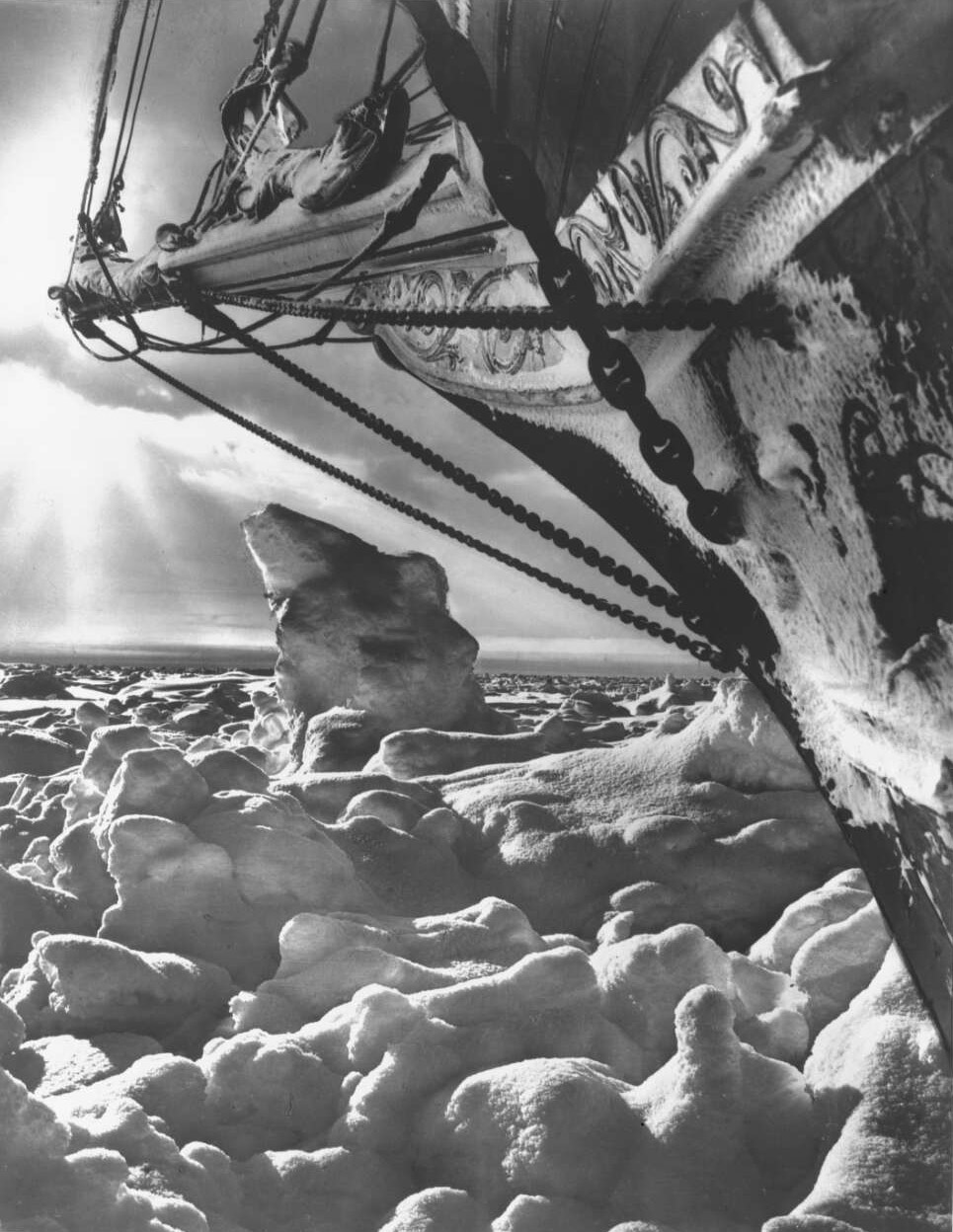
"We reached the head
of the Weddell Sea,
but impenetrable barriers of old
ice
frustrated further progress" - The Endurance
Beset in pack ice, disaster, an adventure to try to reach land and eventually a temporary reprive.
The Endurance battled her way through a thousand miles of pack ice over a six week period and was one hundred miles - one days sail - from her destination, when on the 18th of January 1915 at 76°34'S, the ice closed in around her. The temperature dropped dramatically cementing together the loose ice that surrounded the ship as the ship's storekeeper wrote, she was:
"Like an almond in a piece of toffee".
On the one hand this was not totally unexpected, it had happened to ships in the Antarctic and Arctic many times before, but it was a significant setback and for Shackleton, the disappointment must have been bitter. He was 40 years old, his country was at war, the expedition had taken huge amounts of effort and energy to prepare, he was unlikely to have this opportunity again.
Nevertheless, his men looked towards "the Boss" as they called him. This collection of Royal Naval sailors, rough and ready trawler hands and recent Cambridge University graduates amongst others were now dependent on the man who had led them to this place and this very unfortunate predicament.
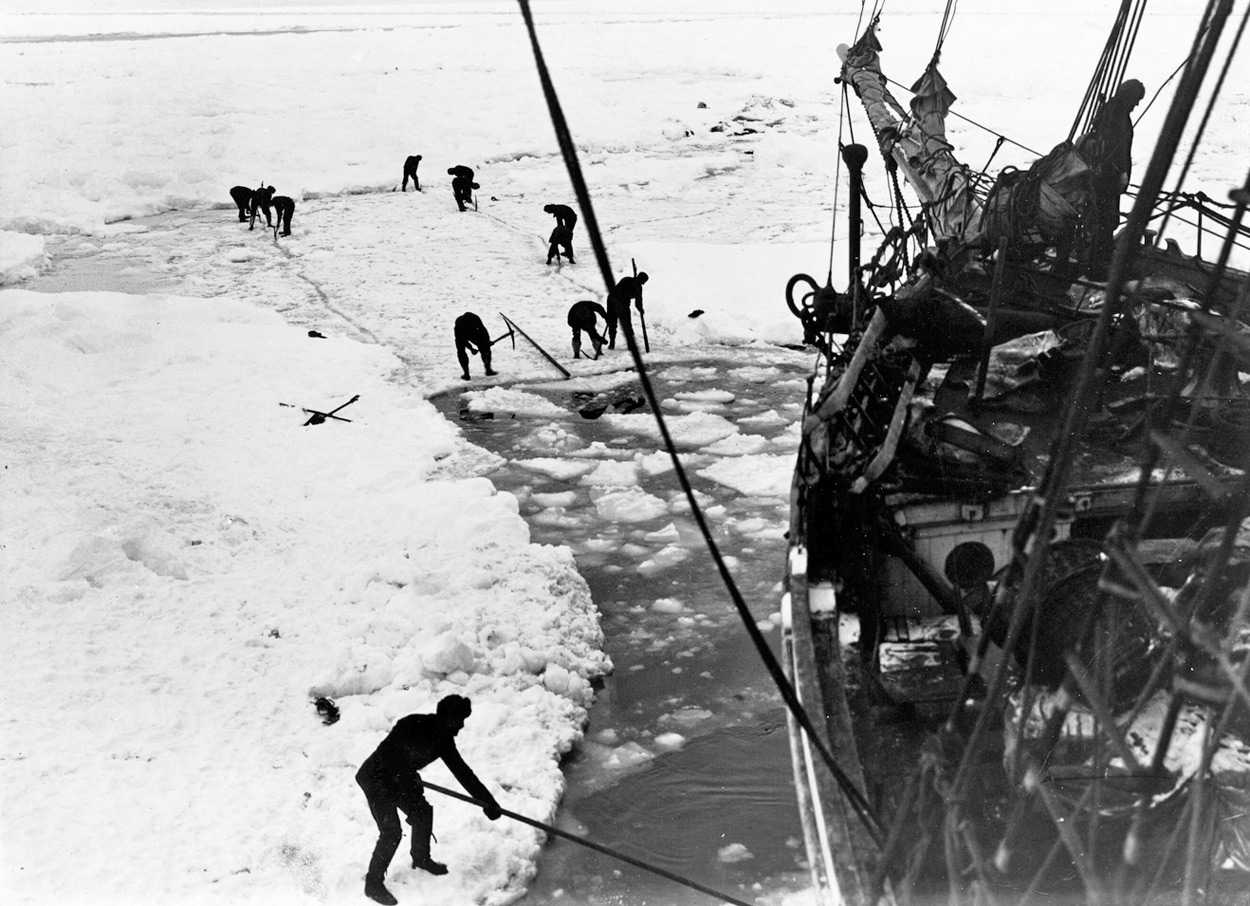
For two days and nights every endeavour
was made to cut the ship free but the temperature continued
to fall and the ice which was broken, froze again, and matters
in the end were worse than before - 14th February 1915
The ship was drifting to the southwest with the ice. Attempts were made to free the ship when sometimes cracks appeared in the ice nearby, but to no avail. The ice around the ship itself was thick and solid. Men with heavy improvised ice chisels and iron bars breaking the ice up near the ship and the ship at full speed ahead had no effect at all, they continued to drift.

As time wore on it became more and more
evident that the ship was doomed.
Endurance among
ice pinnacles, February 1915
By the end of February, temperatures had fallen and were regularly -20°C, the ship was now clearly frozen in for the winter. The worry was where the drifting ice would take them and would it be possible to break out in the spring? The sides of the ship were cleared so that if the ice began to press together, then hopefully the Endurance would be able to rise above the ice and ride on it rather than being crushed.
This eventuality had not really been planned for and the men became frustrated and restless, football and hockey games were regular features on the sea ice until the darkness of the Antarctic winter began. Sunrise glows came in early July heralding the return of the sun and daylight, but the weather was not kind with regular blizzards and low temperatures. Most worrying of all was the pressure from the ice, floes began to "raft" over each other.
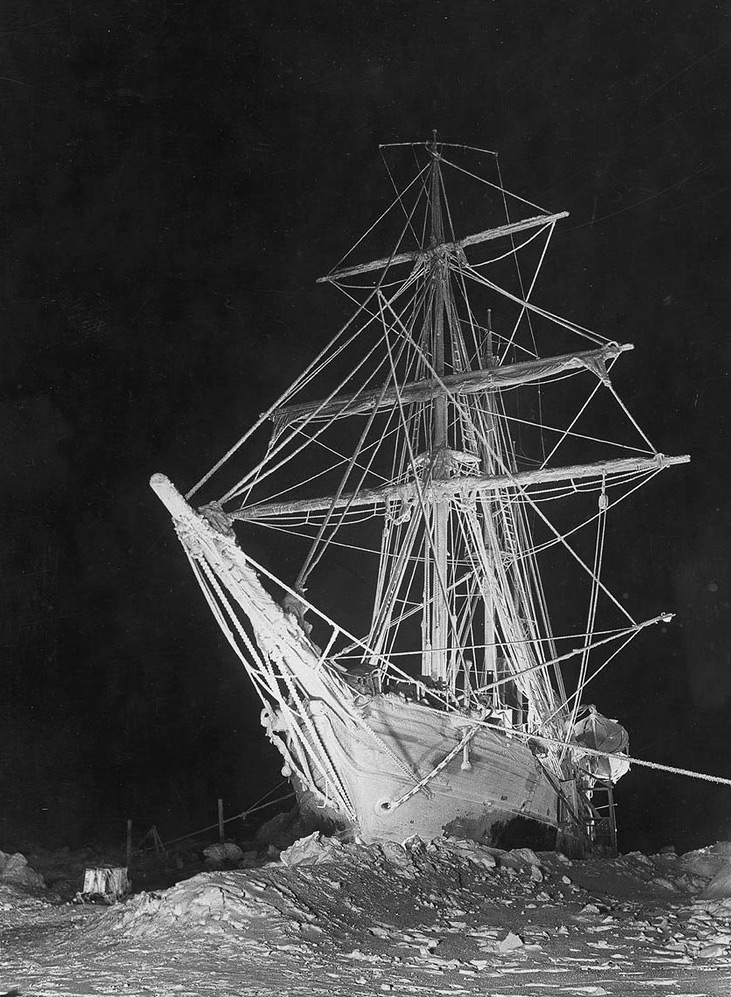
The long, long night the Endurance in the Antarctic
winter darkness, trapped in the Weddell Sea, 27th
August 1915
During the night take flashlight of ship beset by pressure.
This necessitated some 20 flashes, one behind each salient
pressure hummock, no less than 10 flashes being required
to satisfactorily illuminate the ship herself. Half blinded
after the successive flashes, I lost my bearings amidst
hummocks, bumping shins against projecting ice points &
stumbling into deep snow drifts.
- Frank Hurley's
diary
Everyone knew that one of two things would happen, either the pack ice would thaw, break up and disperse in the spring, so freeing the ship, or it would consolidate and driven by the effects of wind and tide over hundreds of miles of sea would take hold of and crush the ship - like a toy in a vice.
The men went out to look for fresh meat for the dogs and themselves in the form of seals and penguins, they were still in low supply having disappeared at the start of winter, a few were taken at the end of September.
On Sunday, October 23rd 1915 their position was 69°11'S, longitude 51°5'W. The Endurance was under heavy pressure from the ice and not held in a good position, instead of being able to slip upwards with the increasing pressure, the ice had hold of her. The first real damage was to the stern-post which twisted with the planking buckling in the same area, she sprang a leak. The bilge pumps were started and the leak was initially kept in check.
"The ice is rafting up to a height
of 10 or 15 ft. in places, the opposing floes are moving
against one another at the rate of about 200 yds. per hour.
The noise resembles the roar of heavy, distant surf. Standing
on the stirring ice one can imagine it is disturbed by the
breathing and tossing of a mighty giant below"
Shackleton
On October 27th Shackleton wrote, "The position was lat. 69°5'S, long. 51°30'W. The temperature was -8.5°F, a gentle southerly breeze was blowing and the sun shone in a clear sky. After long months of ceaseless anxiety and strain, after times when hope beat high and times when the outlook was black indeed, we have been compelled to abandon the ship, which is crushed beyond all hope of ever being righted, we are alive and well, and we have stores and equipment for the task that lies before us. The task is to reach land with all the members of the Expedition. It is hard to write what I feel".
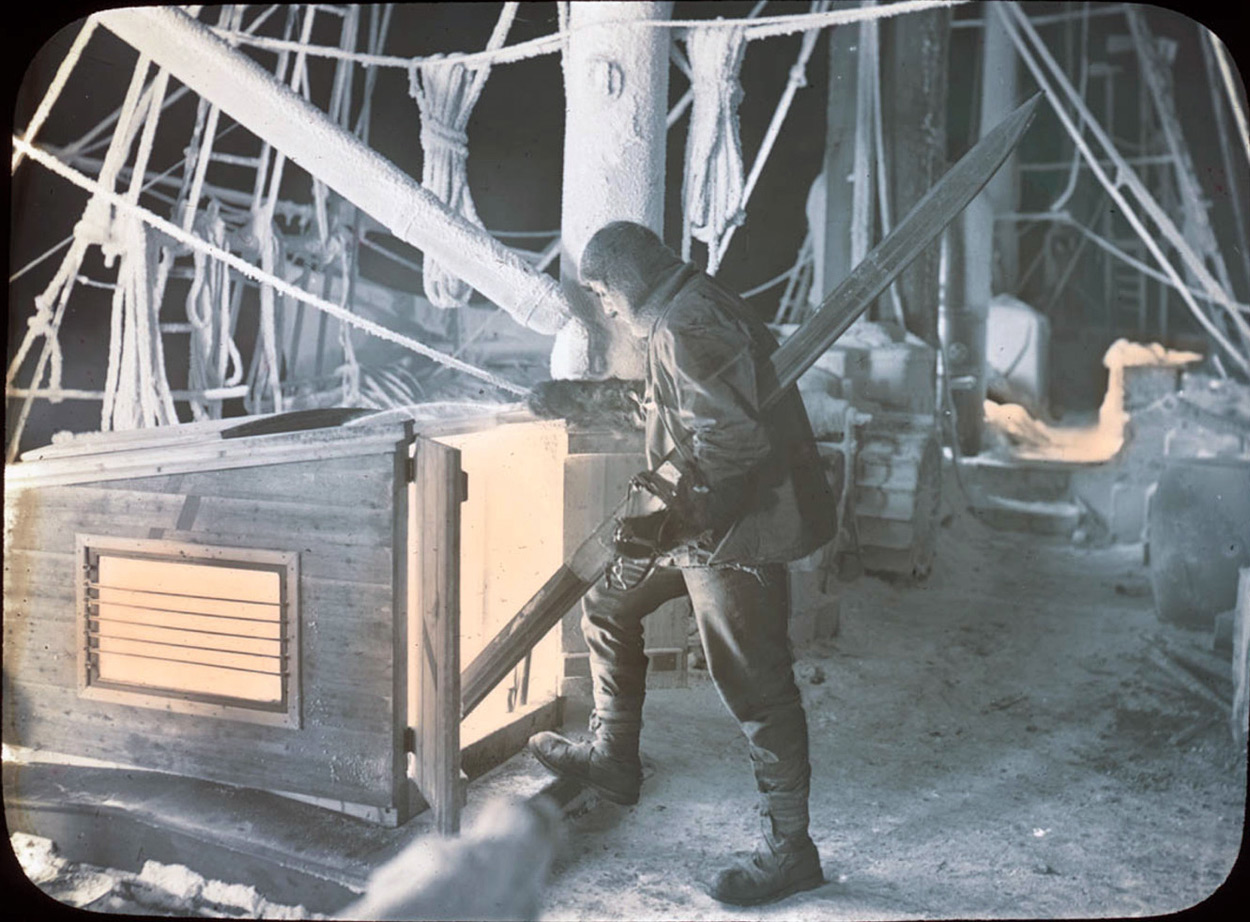
The nighwatchman returning after his
rounds
The Endurance had drifted at least 1186 miles since first becoming fast in the ice 281 days previously, she was 346 miles from Paulet Island, the nearest point where there was any possibility of finding food and shelter.
Shackleton ordered the boats, gear, provisions and sledges lowered onto the ice. The men pitched five tents 100 yards from the ship but were forced to move when a pressure ridge started to split the ice beneath them. "Ocean Camp" was established on a thick, heavy floe about a mile and a half from what was fast becoming the wreck of the Endurance.
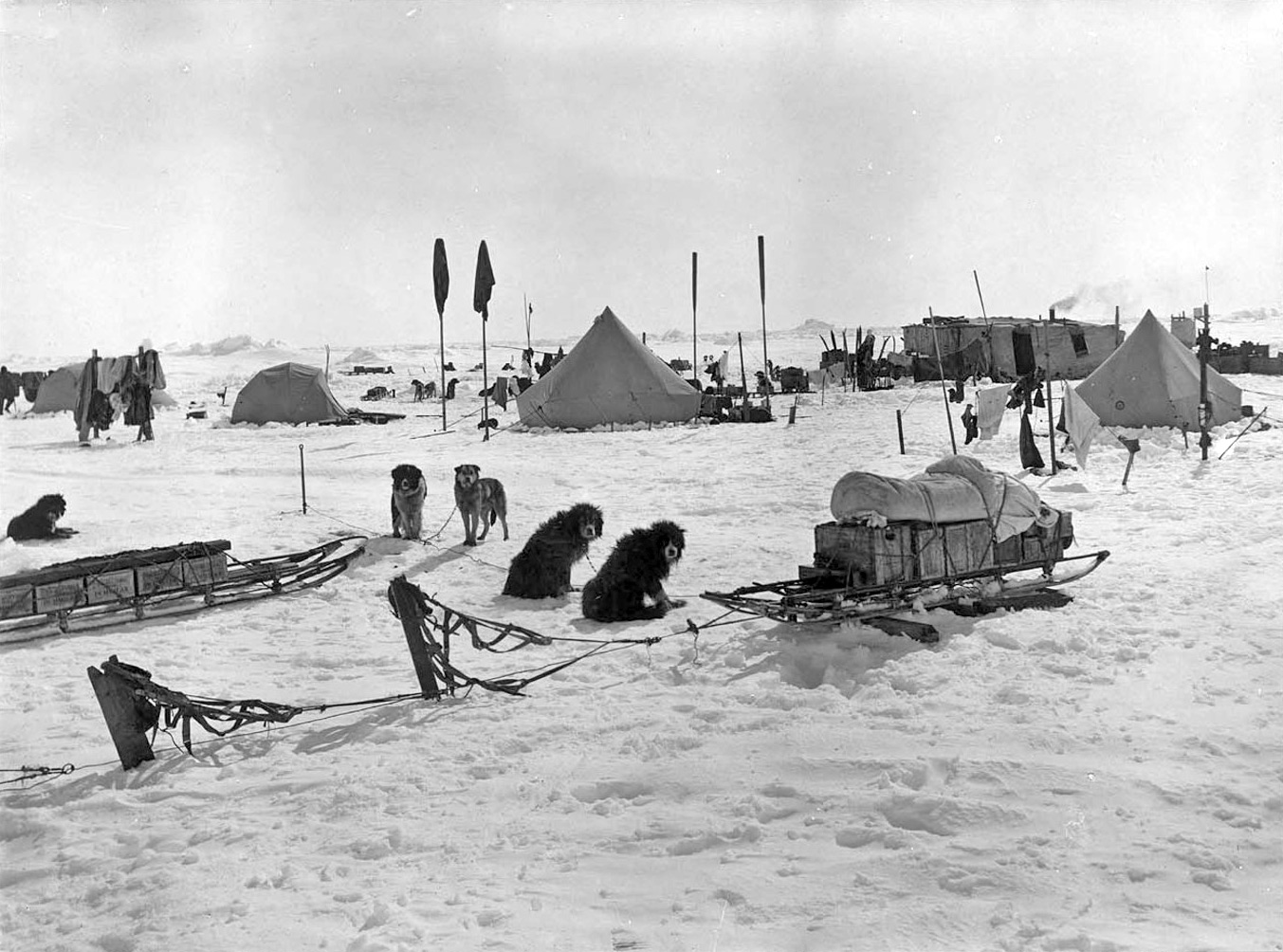
Ocean Camp, supplies were collected from
the failing ship and laid on the ice
The Endurance finally broke up and sank below the ice and waters of the Weddell sea on November 21st 1915. The men had saved as many supplies as they could (including Frank Hurley's precious photo archive, the source of the pictures on this page) before she disappeared.
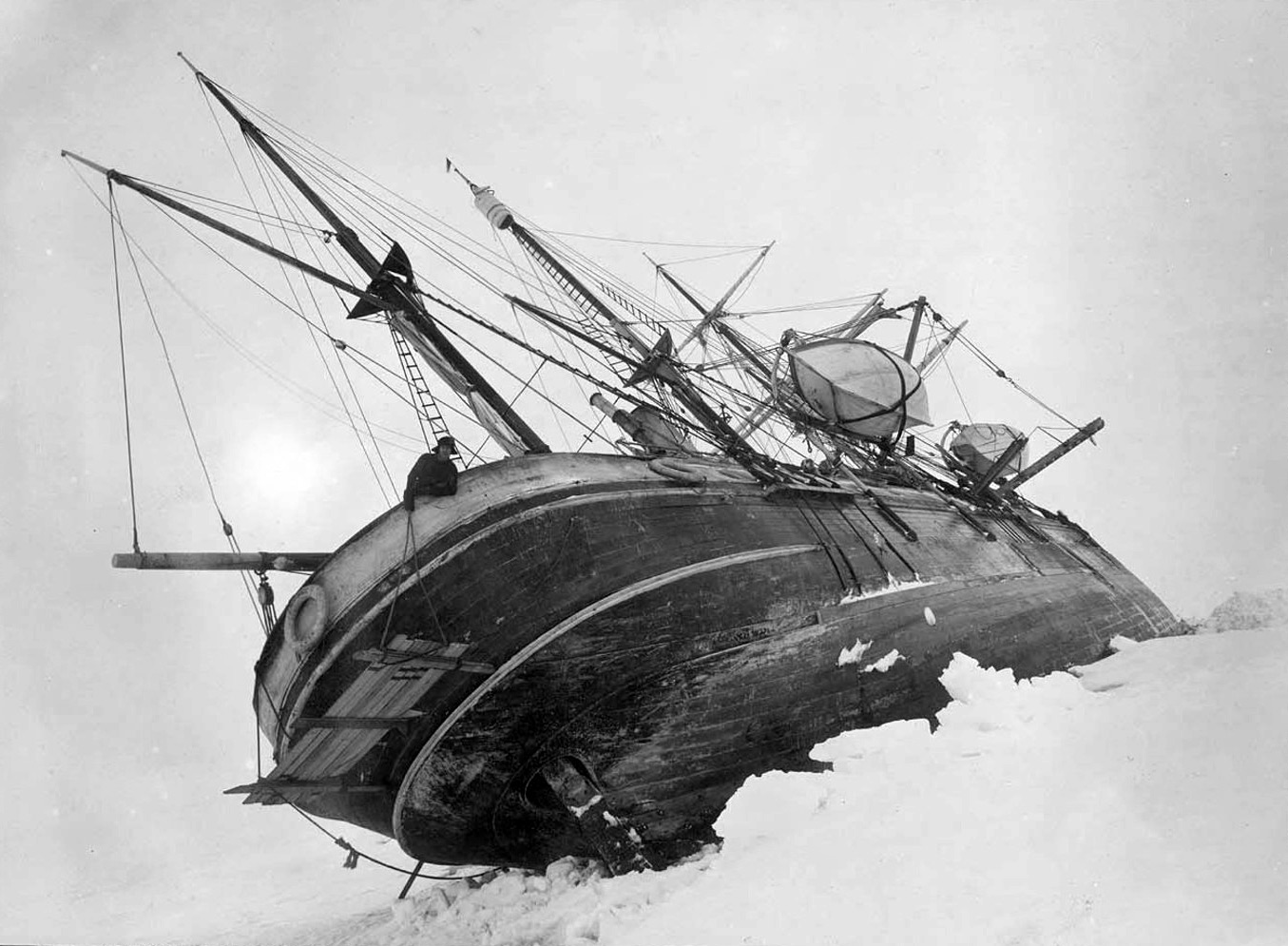
The beginning of the end for Endurance,
now completely in the power of the ice,
the ship begins to
keel over
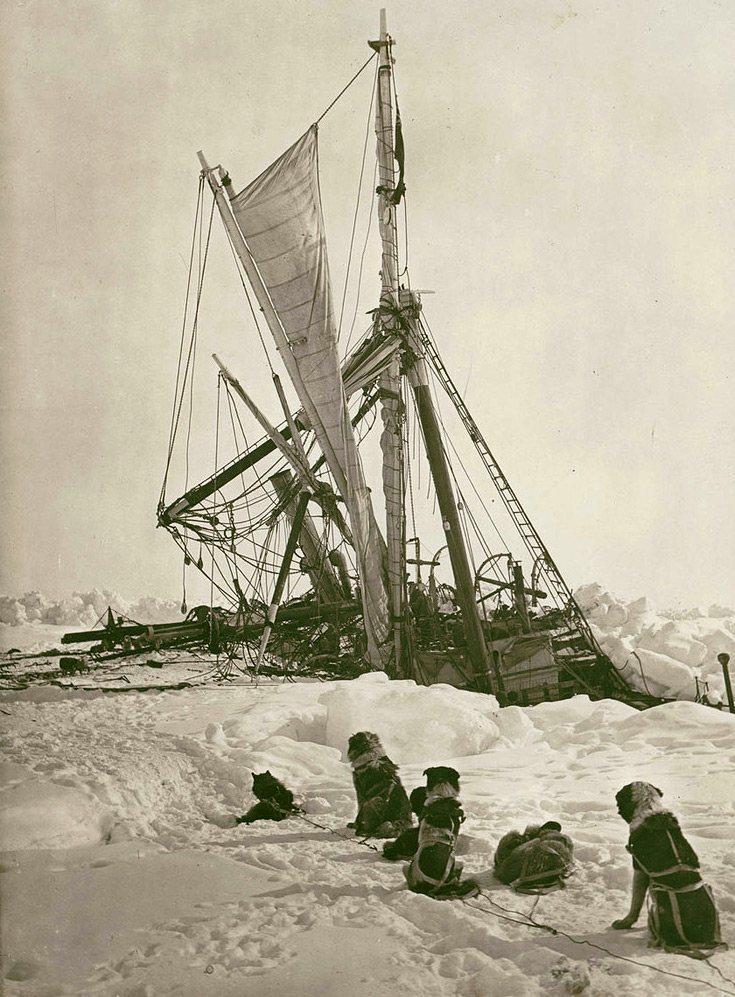 Endurance crushed to death by the icepacks of the Weddell
Sea,
Endurance crushed to death by the icepacks of the Weddell
Sea,
the sinking ship, watched by the dogs, 1st
November 1915
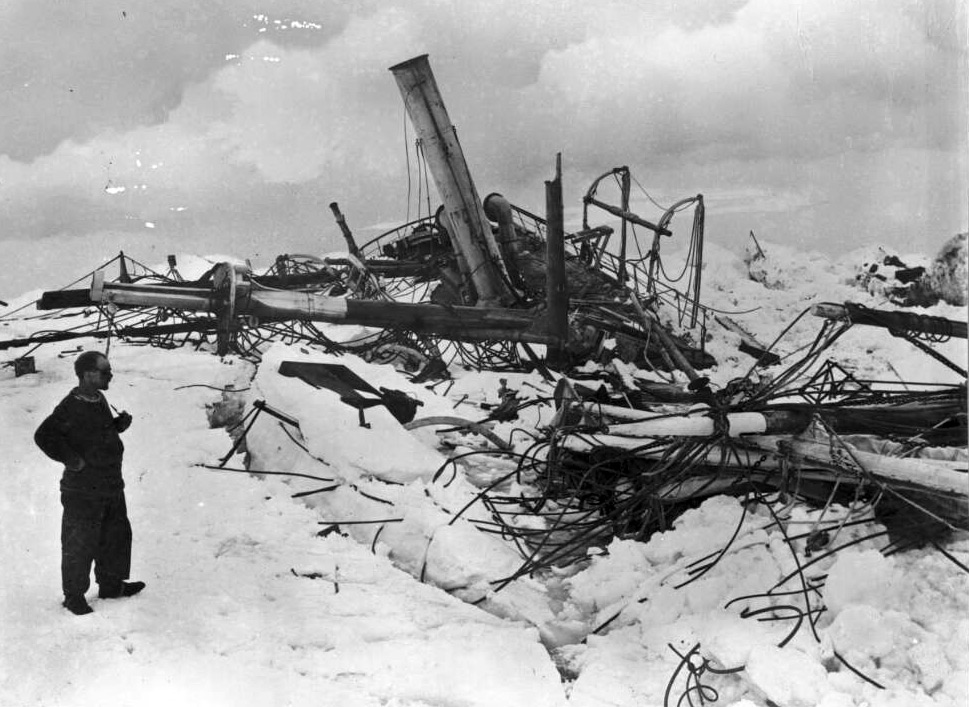
Frank Wild by the wreckage of the Endurance before she
slipped beneath the ice.
The 28 men of the expedition were now isolated on the drifting pack ice hundreds of miles from land, with no ship, no means of communication with the outside world and with limited supplies. What was worse was that the ice itself was now starting to break up as the Antarctic spring got under way. On December 20th Shackleton decide that the time had come to abandon their camp and march westward to where they thought the nearest land was, at Paulet Island.
They had three lifeboats named after patrons of the expedition who had donated funds. Two of these were now manhauled in relays, the James Caird and Dudley Docker. The third boat, the Stancomb Wills was left behind. If the ice began to disappear under them, the men would take to the 20 foot boats.
Some of the crew led by Frank Wild returned to the area where the Endurance had been to retrieve the Stancomb Wills to give them more space, it would prove to be a wise decision in the months to come. They were all forced into the boats by the thinning and increasingly fragile ice on April 9th 1916 and made their way across a stretch of open water, by the evening they were able once again to haul the boats onto a large ice floe and pitch their tents.

Hauling up the boats for the night 1916
That the crew kept going during this time was a tribute to Shackleton's leadership skills and his abilities and understanding of the importance of keeping up morale. The whole group were kept together in the monotonous and strenuous task of pulling laden lifeboats across broken up and ridged ice floes. It was now 14 months since the Endurance had become frozen into the ice and nearly 5 months since she had sunk marooning them in a featureless icy wilderness. On April 12th Shackleton found that instead of making good progress westwards, they had actually traveled 30 miles to the east as a result of the drifting ice. They did however spot Elephant Island, part of the South Shetlands group and headed that way in seas that were by now largely open for navigation. They made landfall on Elephant Island being ecstatic to do so. It had been 497 days since they had last set foot on land.
"Thus, after a year's incessant
battle with the ice, we had returned... to almost the same
latitude we had left with such high hopes and aspirations
twelve months previously; but under what different conditions
now! Our ship crushed and lost and we ourselves drifting
on a piece of ice at the mercy of the winds"
Shackleton, On New Year's Eve 1915
Elephant island
Their first landing place wasn't ideal by any means, but they soon found a more appropriate place to make camp at a place they called Point Wild after Frank Wild who had gone down the coast to scout.
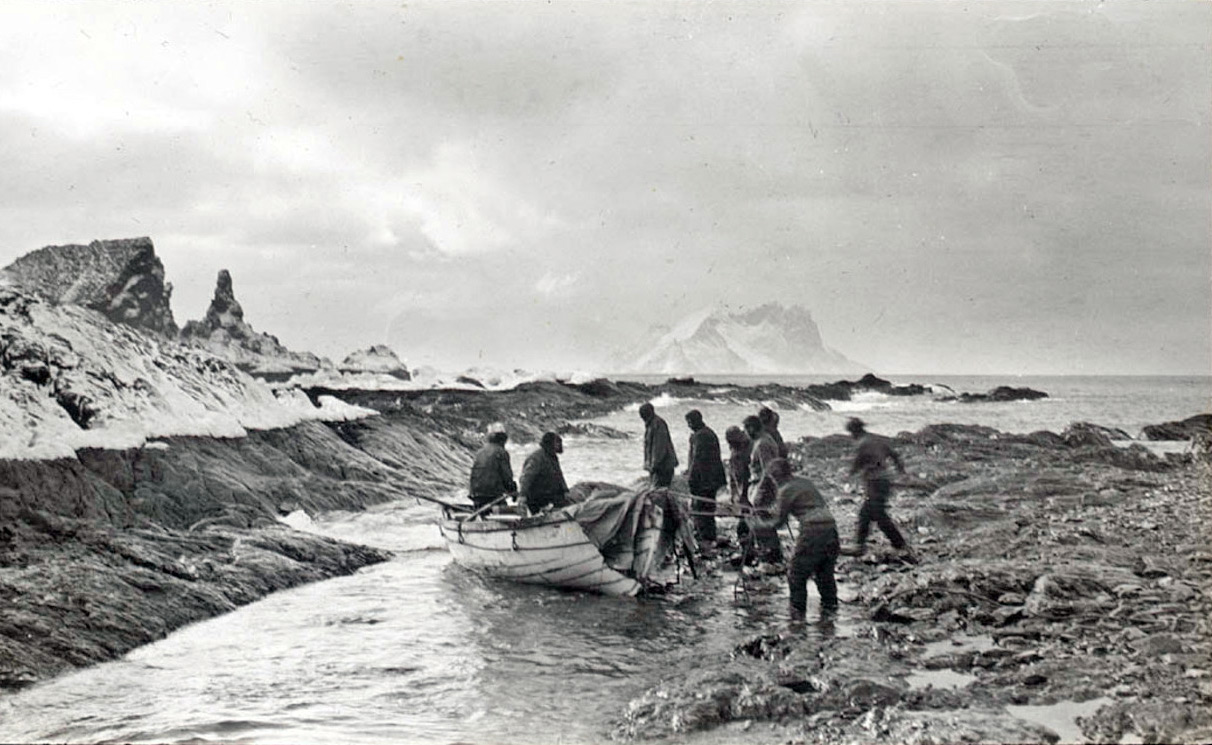
Landing the lifeboats on Elephant
Island, the high tide mark can be seen along the
shore where there is no snow cover, the first thing the
men had to do on arrival was to move away from the sea and
find a better place to camp
"As we clustered round the blubber
stove, with the acrid smoke blowing in our faces, we were
quite a cheerful company...Life was not so bad. We ate our
evening meal while the snow drifted down from the surface
of the glacier and our chilled bodies grew warm"
Shackleton
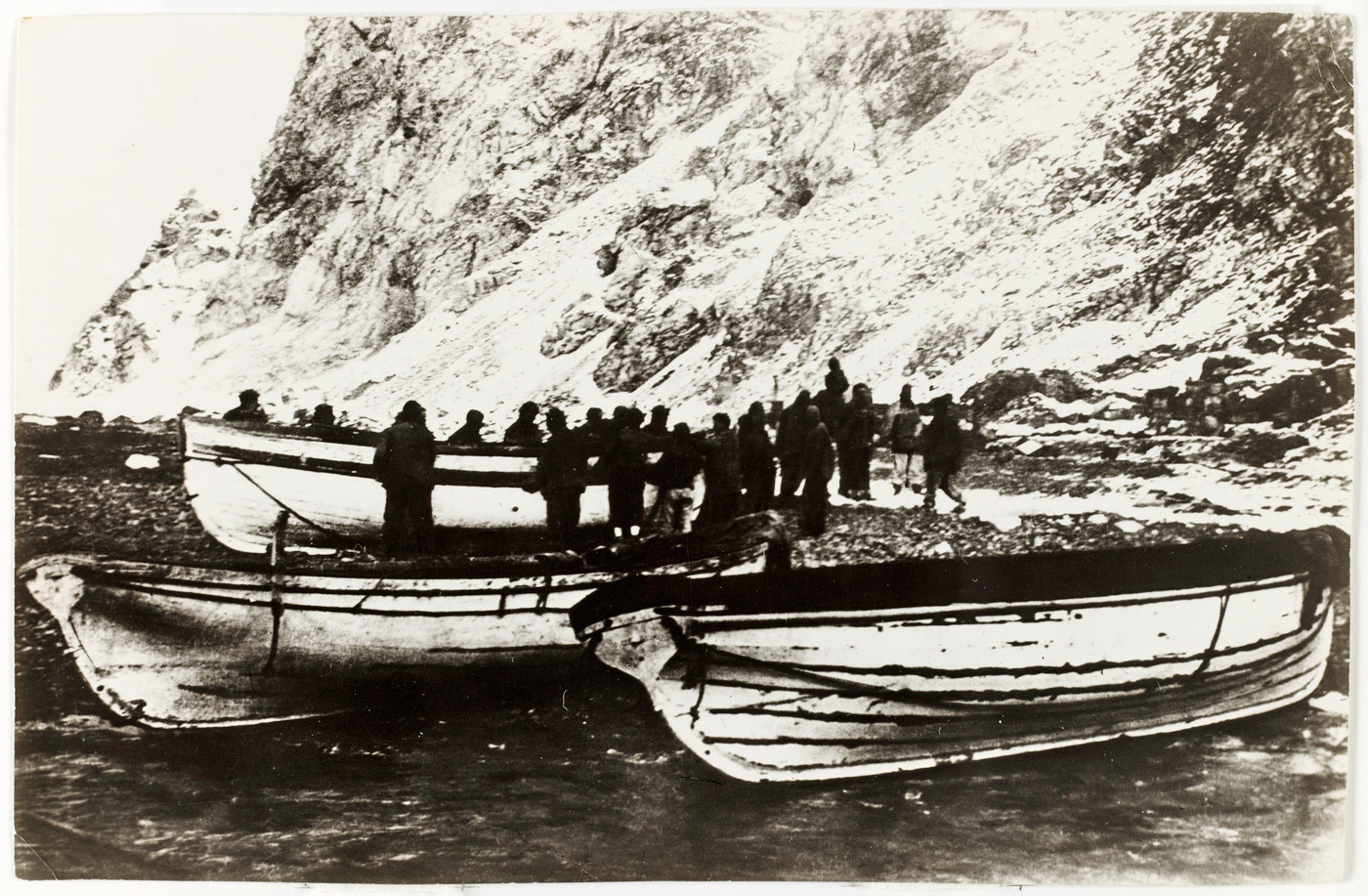
On arrival at Elephant Island,
the three lifeboats, Dudley Docker, James Caird,
and Stancomb Wills with Shackleton and his crew deciding
on the next step.
For the time being they were more safe and secure than they had been for a long time, but they were still stranded far from civilization with no-one knowing where they were or what their condition was. There was no chance of rescue. No ships passed that way. No radio at that time was capable of summoning help.
The outside world was not going to come to Elephant Island.
Shackleton realised that in order to effect a rescue, he was going to have to travel to the nearest inhabited place which was the whaling station back on South Georgia, some 800 miles distant and across the most stormy stretch of ocean in the world. They expected to encounter waves that were 50 feet from tip to trough "Cape Horn Rollers" in a 22 foot long boat. Their navigation was by a sextant and a chronometer of unknown accuracy, they were dependent on sightings of the sun that could sometimes not be seen for weeks in the overcast weather so characteristic of these latitudes.
Shackleton chose Frank Wild to stay behind with the men on Elephant Island as he felt that he could hold them together well. If there was no rescue by the spring they were to try and reach Deception Island which was regularly used by whalers and sealers. The lifeboat chosen for the journey was the James Caird, it was made seaworthy by whatever limited means were available and equipped with a part cover against the weather and the sea. Launching her was eventful with many of the men being soaked to the skin, a serious matter in the cold climate and with very limited facilities for drying their clothes out and getting warm again.
The party left behind on Elephant Island used the two remaining life boats to make a hut, they were turned upside down and placed on top of two low stone walls, tent and sail fabric were used as lining to keep the wind and weather out. The men were even able to make small celluloid windows from an old photograph case, a blubber stove provided heat and was used as a cooker. Conditions were cramped and food was in short supply. One of the party, Blackborow, (little more than a boy who had joined the ship as a stow-away in Buenos Aries when his companion had been hired though he had not) suffered from frostbitten toes. These were amputated by the surgeons by the meager light given out by the blubber stove.
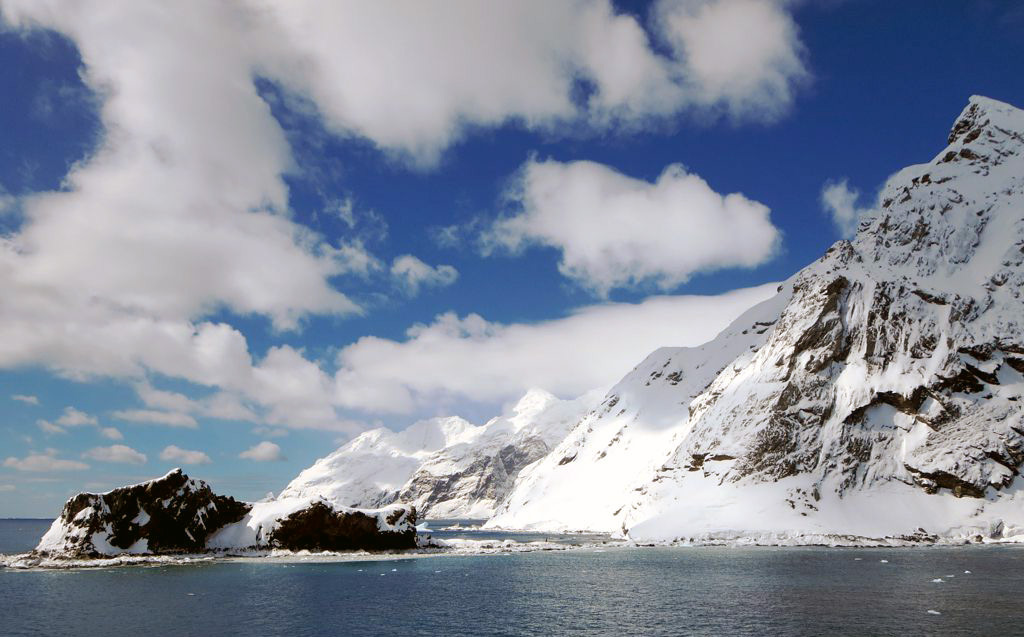
Point Wild, Elephant Island, the site where camp was
made after the initial landing place was identified
as unsuitable
Next page, the voyage of the James Caird
Picture credits, copyright pictures used by permission: Point Wild - by David Stanley from Nanaimo Canada, used under Creative Commons 2.0 Generic license.
Ernest Shackleton Books and Video

South - Ernest Shackleton and the Endurance Expedition (1919)
original footage - Video
Shackleton
dramatization
Kenneth Branagh (2002) - Video

Shackleton's Antarctic Adventure (2001)
IMAX dramatization - Video
The Endurance - Shackleton's Legendary Expedition (2000)
PBS NOVA, dramatization with original footage - Video
Endurance : Shackleton's Incredible Voyage
Alfred Lansing (Preface) - Book
South with Endurance: Frank Hurley - official photographer
Book
South! Ernest Shackleton Shackleton's own words
Book
Shackleton's Way: Leadership Lessons from the Great Antarctic Explorer
Book