Sir Ernest Shackleton Endurance
Expedition - Trans-Antarctica
1914-1917
1 - Departure
1 - this page, departure
|
2 - trapped and crushed |
3 - journey to South Georgia |
4 - rescue
time-line &
map | crew of
the Endurance |
the Ross
Sea Party
"Sir Ernest Shackleton's name will for evermore be engraved with letters of fire in the history of Antarctic exploration" - Roald Amundsen
"After the conquest of the South
Pole by Amundsen who, by
a narrow margin of days only, was in advance of the British
Expedition under Scott,
there remained but one great main object of Antarctic journeying
- the crossing of the South Polar continent from sea to
sea".
- Ernest Shackleton
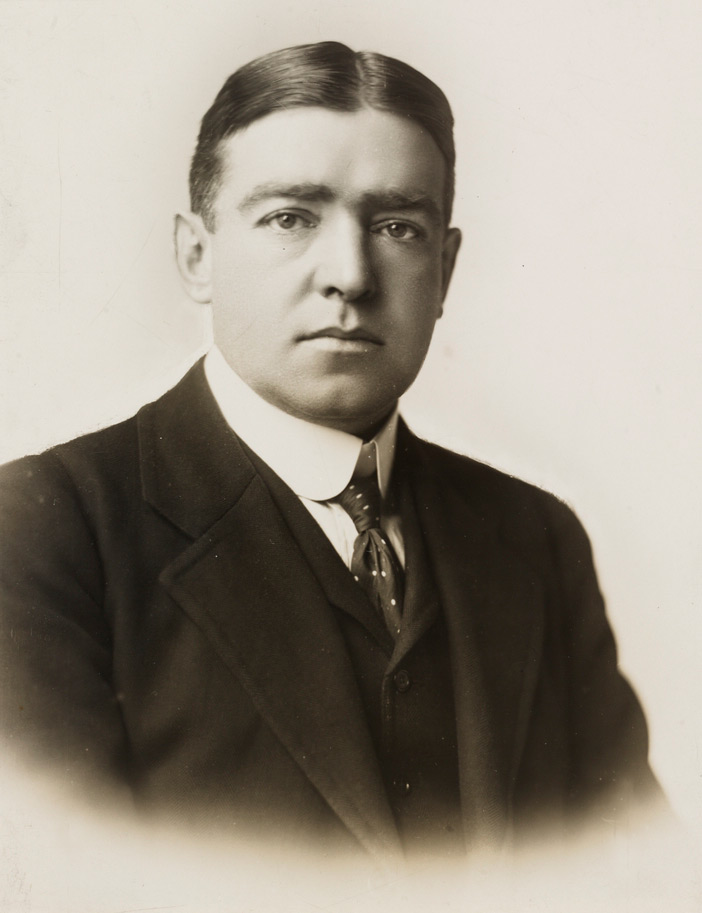
So was born what became the Imperial Trans-Antarctica expedition of 1914 - 1917. The goal was ambitious - audacious even, considering that only 10 men had ever stood at the South Pole and 5 of those had died on the way back. The story that would unfold was to be beyond any expectations and completely different to that planned. It is quite simply one of the most incredible adventure stories of all time. Remarkable even for an era and region that already has far more than its fair share of incredible tales of heroism and fortitude in the face of appalling hardships.
The intention was to cross the Antarctic continent from one coast to the other via the South Pole. In the event, the main expedition never set foot on continental Antarctica. The expedition managed to survive the loss of their ship in the middle of the Antarctic pack ice at a time when there was no chance of contacting the outside world, let alone of being rescued.
It is a classic tale of leadership
and heroism
Preparation
Shackleton began planning his next journey to Antarctica almost as soon as he returned from the Nimrod expedition of 1907 - 1909. He felt certain that others would soon succeed in reaching the South Pole where he had failed having come so close, and so looked to the next goal. This he took as being the crossing of the Antarctic continent from coast to coast via the South Pole, a distance of about 1800 miles, a long way certainly, but not so much further than a "there and back" journey to the pole.
He planned to set out from the Weddell sea region (to the south of South America) across a completely unexplored region of Antarctica, to the pole, and then to the Ross sea / McMurdo sound area (to the south of New Zealand). Typically for such trips, the attention grabbing exploratory part of the expedition was but a small part of a whole. Other scientific and exploratory sledging trips were planned for parties setting out from the main base as well as another party who were to remain at the base and carry out a variety of scientific work. Another group of men would be required to set out from the Ross sea region and lay depots for the trans-Antarctic party to use on their journey to the coast from the pole, they would be on a second ship.
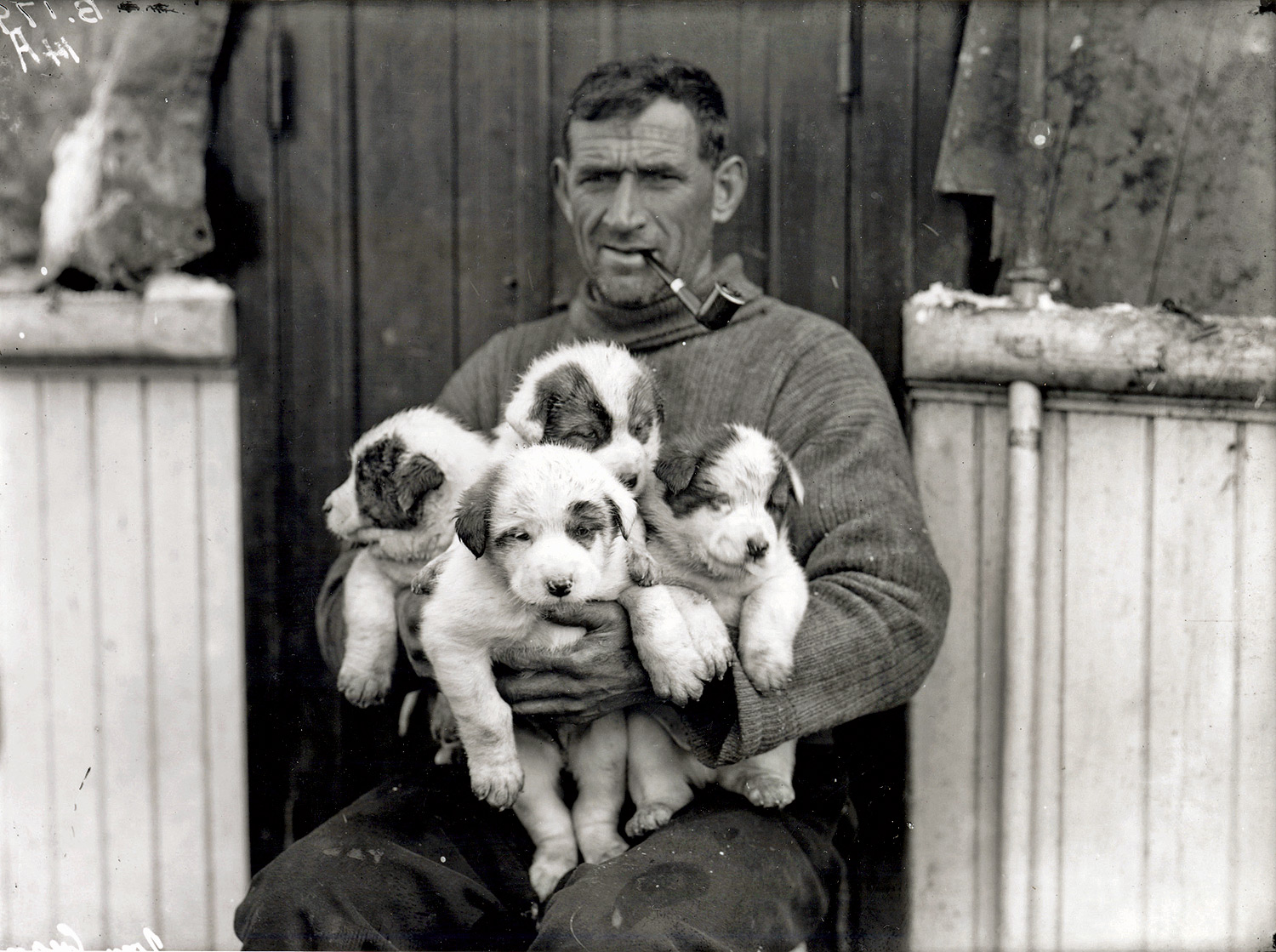
Tom Crean, with a litter of sledge dog puppies on the Endurance
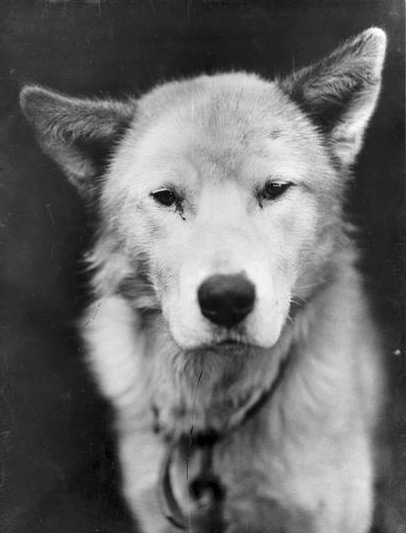 Lupoid, one of Shackleton's
sledge dogs, named for his resemblance to a wolf.
Lupoid, one of Shackleton's
sledge dogs, named for his resemblance to a wolf.
The ship used for the journey to the Weddell sea was newly constructed in a Norwegian shipyard, and had been intended for tourist cruises in the Arctic. She was the Endurance. The ship to take the Ross Sea party was the Aurora purchased from Douglas Mawson and used by his 1911 - 1914 Antarctic expedition. The expedition was inundated with applications from volunteers to join, despite (or maybe because of) the tragic end of Robert Scott and his team after reaching the South Pole only two years beforehand.
There is a much publicized, but almost certainly apocryphal newspaper advertisement supposedly placed by Shackleton (no trace of a copy has ever been found in any archive).
"MEN WANTED: FOR HAZARDOUS JOURNEY.
SMALL WAGES, BITTER COLD, LONG MONTHS OF COMPLETE DARKNESS,
CONSTANT DANGER, SAFE RETURN DOUBTFUL. HONOUR AND RECOGNITION
IN CASE OF SUCCESS.
- SIR ERNEST SHACKLETON"
Funding became a problem and so Shackleton found himself recruiting and preparing for the departure of the Endurance while also desperately struggling for funds that if not forthcoming might result in the expedition not taking place at all. Eventually however, funding was obtained and towards the end of July 1914 preparations were almost complete.
The dark clouds of World War 1 were beginning to gather however. The Endurance was anchored off Southend on August 4th 1914 when Shackleton read in a daily newspaper the order for general mobilization of troops and supplies along with calls for volunteer soldiers. He immediately returned to the ship, gathered all hands, and told them that he would send a to telegram the Admiralty offering the ships, stores and services to the country in the event of war breaking out. Within an hour after sending the telegram, Shackleton received a reply from the Admiralty with the single word "Proceed". Within two hours, another arrived from Winston Churchill in which he thanked them for their offer but desired that the expedition go on. That night, at midnight, war broke out.
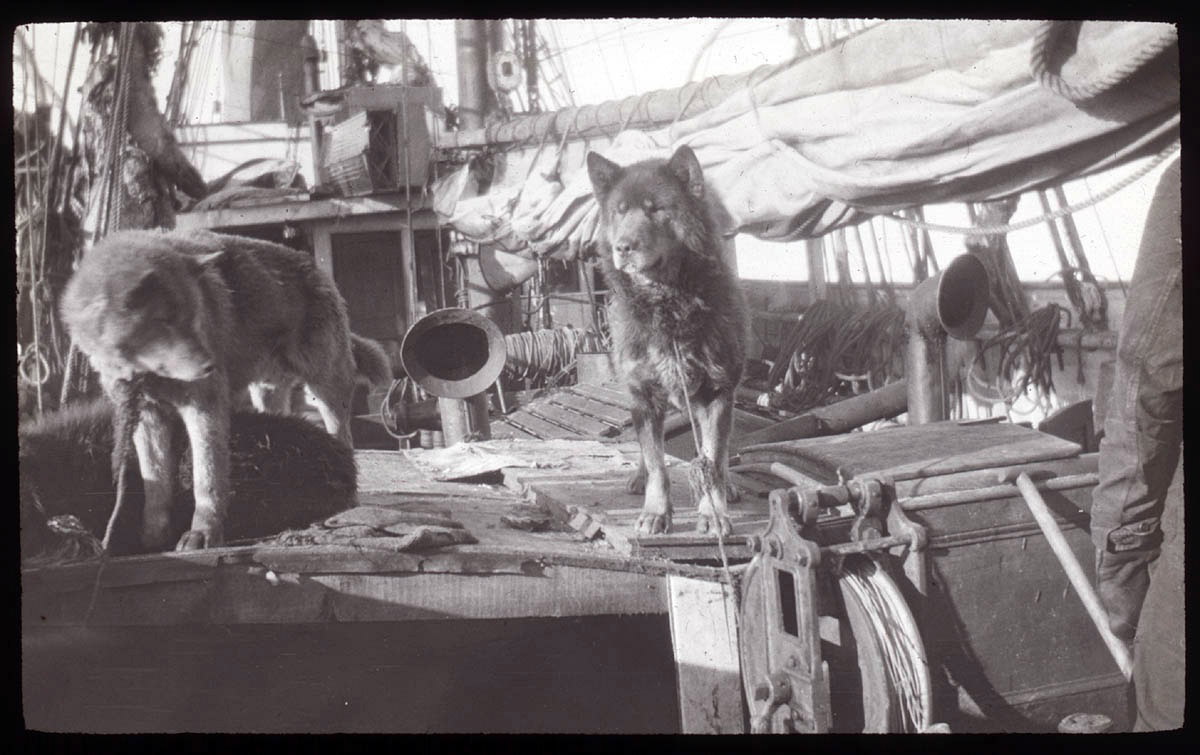
Dogs on the deck of the
Endurance while sailing south,
the picture also gives an
idea of the small size of the ship.
On August 8th the Endurance sailed for the Antarctic via Buenos Aires and the sub Antarctic island of South Georgia where there was a Norwegian whaling station. It was thought that the war would be over within six months so when it came time to leave for the south, they left with no regrets.
On November 5th 1914 they arrived at South Georgia. Shackleton learnt much from the whaling captains about the conditions between there and the Weddell Sea which indicated that this was a particularly heavy ice year. The plan had been to spend only a few days collecting stores, but instead the Endurance remained at South Georgia for a month to allow the ice further south to disperse. This month was one where bonds of friendship and mutual respect were formed between the Endurance crew and the Norwegian whalers. Bonds that were to prove unexpectedly useful some time later to Shackleton and his men.
The Weddell Sea was known to be particularly ice bound at the best of times and the Endurance left with a deck-load of coal in addition to normal stores to help with the extra load on the engines when it came to pushing through pack ice in the Weddell Sea to the Antarctic continent beyond. Extra clothing and stores were taken from South Georgia in the event that the Endurance may have to winter in the ice if caught in the Weddell Sea as it froze, unable to reach the continent first. They left South Georgia on the 5th of December 1914.
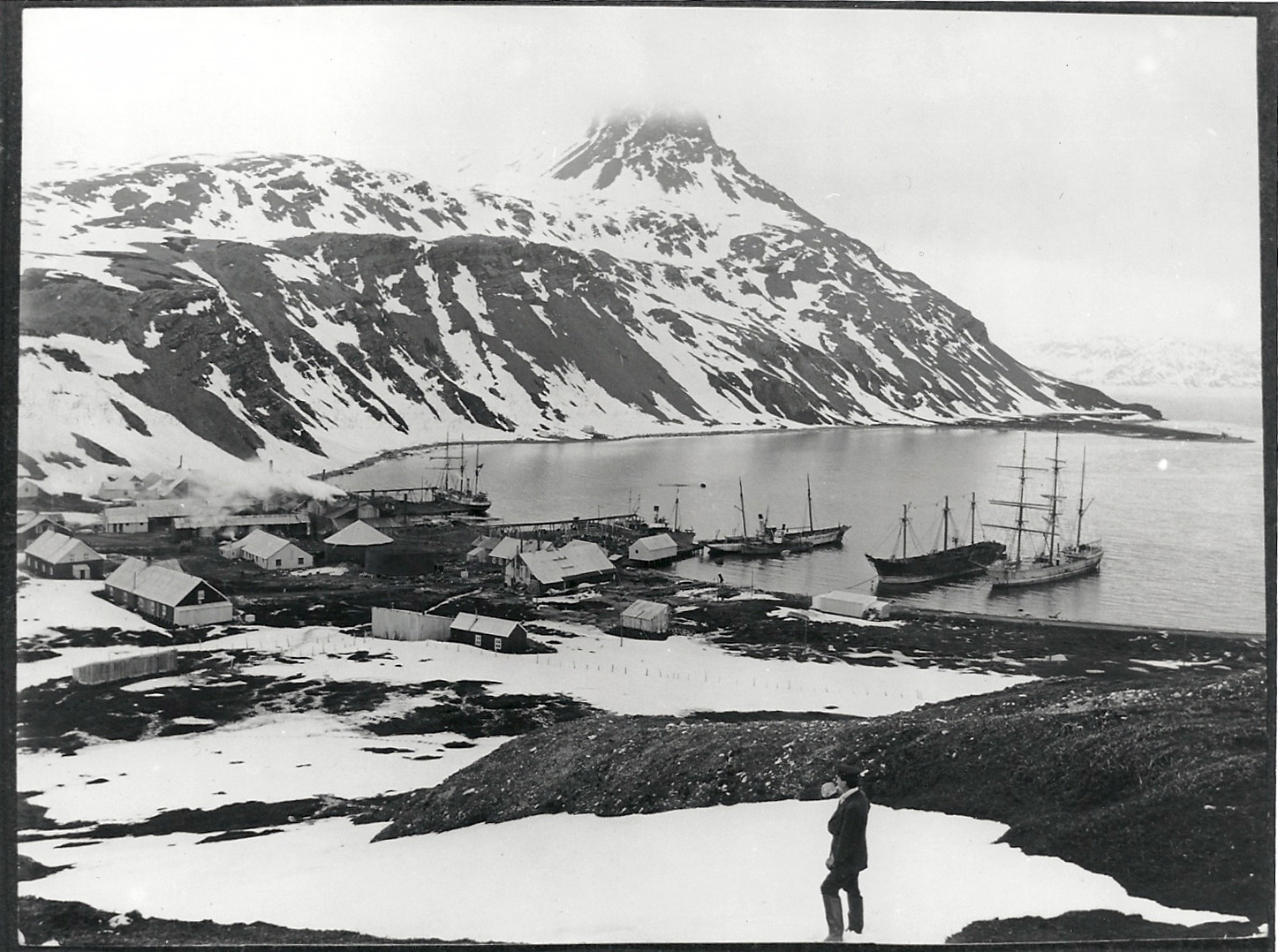
The Endurance can be seen
at a jetty toward the left of this picture taken overlooking
Grytviken whaling station on South Georgia before sailing for
the South.
Ernest Shackleton Books and Video

South - Ernest Shackleton and the Endurance Expedition (1919)
original footage - Video
Shackleton
dramatization
Kenneth Branagh (2002) - Video
Shackleton's Antarctic Adventure (2001)
IMAX dramatization - Video
The Endurance - Shackleton's Legendary Expedition (2000)
PBS NOVA, dramatization with original footage - Video
Endurance : Shackleton's Incredible Voyage
Alfred Lansing (Preface) - Book
South with Endurance: Frank Hurley - official photographer
Book
South! Ernest Shackleton Shackleton's own words
Book
Shackleton's Way: Leadership Lessons from the Great Antarctic Explorer
Book