
Ansel Adams
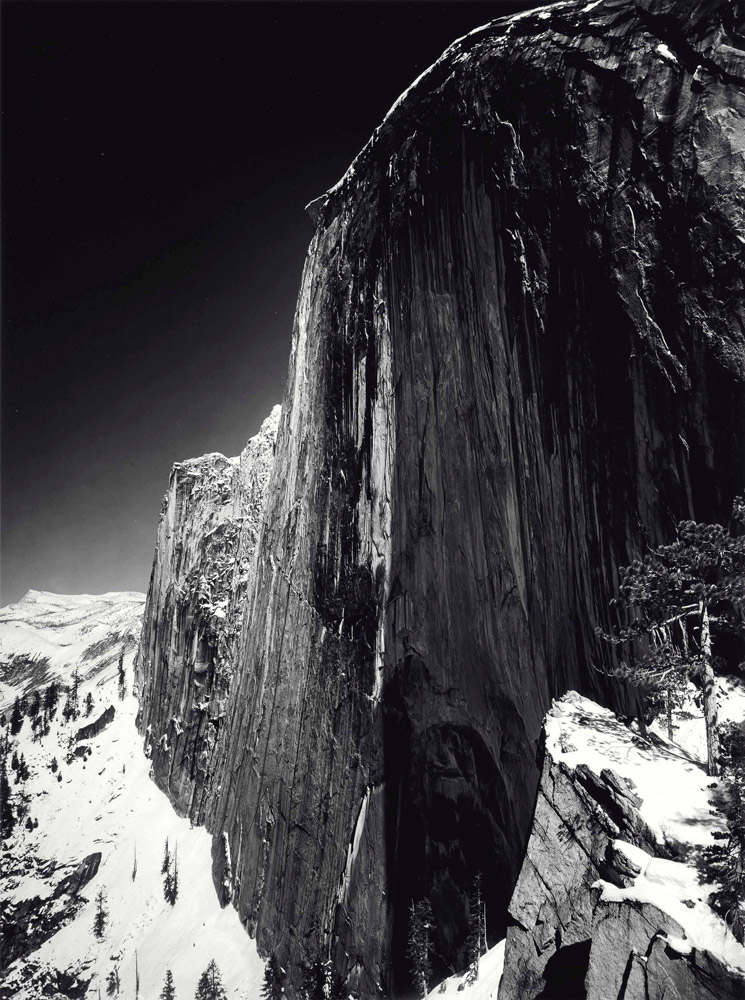
Monolith the Face of Half Dome
Yosemite
National Park - 1927
Monolith was the first widely recognized and acclaimed picture that Ansel Adams produced.
The making of the picture
View price and framing options
It was this image that really showed the world the future potential that Adams had. It was taken on April the 10th in 1927 on a day when Adams was climbing and taking photographs with his then fiancee Virginia Best and three friends Charlie Michael, Arnold Williams and Cedric Wright (Ansel's best friend).
He was 25 at the time and laden with his 6 1/2 x 8 1/2 inch Korona view camera with two lenses, two filters, a wooden tripod and twelve glass plates that were his negatives.
They climbed up Le Conte gully under the north cliff of Grizzly peak, it was an area that Adams knew well having spent four summers from 1919 as "keeper" of the Sierra Club's Le Conte memorial lodge in Yosemite valley.
It was a cold and exhilarating morning particularly in the shadow of the gully. Some pictures were taken on the way up the climb with some problems caused by the wind making the camera shake despite the heavy tripod used. The clear sky meant that a dark filter was being used that required a considerable extra exposure to compensate for the cut down in light admitted. The compensation being that the bright blue sky was rendered in dark rich tones against the foreground material.
Adams had already exposed ten of his twelve plates with varying degrees of success before he turned to the face of Half Dome.He arrived in position at about noon when the subject was in full shadow and so waited until "early mid-afternoon" when the sun began creeping up on the scene before setting himself up to take the photograph.
Adams had a vision of the picture that he wanted to take and tried a first exposure (number eleven of twelve) with a yellow filter, realizing almost immediately that the picture would not give the effect of sunlight and shadow that he required. By the time he made his next and final exposure he had chosen the much darker red filter that had an exposure factor of 16. Aware that he had an exceptional image before him that he wanted to capture correctly he exposed the plate for 5 seconds at f22. Fortunately it went well and no wind was present to shake the camera on its tripod, Adams took care to protect the precious plate on the long hike home back to the car where they arrived at dusk.
The picture is also significant in that it represents Adams very first conscious "visualization" of the final image as it would appear with the filter in place. This was a technique that was to become more and more important to Adams over the years as he became more competent with increased experience at applying the technique.
The negative itself was almost lost in a darkroom fire in 1937. Having almost literally just arrived back from a four day trip with some friends in Yosemite, the companions were relaxing in the evening they became aware of a fire. They managed to salvage many negatives including a good number of glass plates and spent several days cleaning and drying them.
This negative was slightly damaged at the top and at the left hand edge, subsequent prints requiring the trimming of about 1/4 of an inch from these sides. Adams never considered a picture complete once the negative had been developed and continuously printed and re-printed many of his best negatives throughout his life. He considered that many of his later prints of this negative, decades after the original had been taken, to be far better in terms of mood and substance than earlier prints.
In some ways Adams approach to his negatives can be likened to a composer and his music. Once obtained the negative was something to be interpreted later on in different ways and as he became more and more proficient in his art, so he re-interpreted many of his early compositions in deeper and more revealing ways.
The excitement of seeing this, the first visualization come true when removed it from the fixing bath was described as "..one of the most exciting moments of my photographic career."
The Face of Half
Dome by Ansel Adams
View price
and framing options


Bibliography- Examples: The Making of 40 Photographs by Ansel E. Adams