|
|
|
||
 |
|
|||||
| Antarctica Picture | Antarctica Cruise | Facts | History | Boots | Store | Clothes | Whales | Books | Video | Schools | Forum | Site Map | FIDS / OAE's |
| Click on small picture to go to main page with larger picture. | Click on title to go to fact file Back to gallery |
|
Thumbnails: Weather |
Nacreous Clouds |
Sea-ice |
Icebergs 1
bergs2 |
Mountains 1
2 |
Diving 1
2 |
Fishing |
|
| 1/ Preparing the fishing hole in sea-ice |
 Preparation of an ice-hole to set a fishing net under sea ice. The snow has been pushed back from the surface and this saw with a special ice blade is being used to cut a hole through the ice. Once cut, the floating square is cut into quarters and the then each quarter pushed under the ice where it's buoyancy keeps it in place. Not too bad a job until you hit the sea, then the blade sprays you with exceptionally cold water. Two holes like this are cut slightly further apart than the length of the fishing net that will be used here. This is a fairly shallow net, set in about 15m of water.
|
| 2/ Send a diver, or two, down the hole with a handy rope |
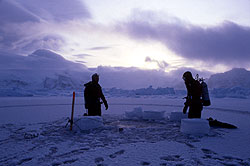 Once the hole has been cut and ice removed if possible (as here) or pushed down under the surface if the blocks are too heavy - it's time to send a diver from one hole to the other with a rope. Usually two divers are sent down, in this case one of these guys has done it before and for the other it's his first time. A skidoo drives from one hole to the next, so the tracks can be seen through the ice as a lighter strip. The divers follow this at a depth of 5-10m and surface through the second hole. The rope is then secured at both ends to a stake hammered into the ice. This only needs to be done the once, these holes can be used until the ice breaks up.
|
| 3/ Go on, stop stalling, get down the hole! |
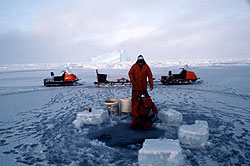 Swimming between two ice holes in the relative shallows isn't too bad as it's quite light and you can see the bottom, but this was out in much deeper water 60m+. The sea-ice cuts out a lot of the light reaching beneath it and in such deep water there is nothing to see as a visual cue. The diver in this case is dependent on his depth gauge to stay at the right level and the line "drawn" by the skidoo on the surface that he is following to the next hole. Eventually, the next hole comes into sight and light shines down like a beacon.
|
| 4/ Great relief! the divers surface at the other hole |
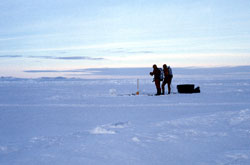 It's
a very eerie place to be even before you go under water. On
this day, there was no wind at all, the visibility was crystal clear
for tens of miles around and the world was a monochrome of blues.
Then the divers go down the hole in the ice and you really totally
alone and silent. It really is a great relief when you see them
appear at the second hole! They didn't stay in any longer than necessary
as there was simply nothing nothing to see. Two divers rather than
just one helps here as they form a visual cue for each other while
swimming through the blue. It's
a very eerie place to be even before you go under water. On
this day, there was no wind at all, the visibility was crystal clear
for tens of miles around and the world was a monochrome of blues.
Then the divers go down the hole in the ice and you really totally
alone and silent. It really is a great relief when you see them
appear at the second hole! They didn't stay in any longer than necessary
as there was simply nothing nothing to see. Two divers rather than
just one helps here as they form a visual cue for each other while
swimming through the blue. |
| 5/ The view from one fishing hole to the next |
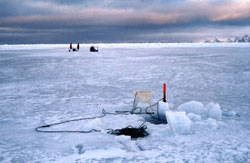 It's probably one of the oddest jobs I've ever done, a combination of where it happened and what I was doing. It was always a help if it was a little windy I felt as if it was flat calm, you were aware of being in a vast landscape and rather more exposed than was entirely comfortable. The rope that the divers had placed had a net tied onto it, the guy/s at the other end of the rope would pull the net through the hole until they saw the end of it. At this point it would be hanging like a curtain underneath and against the ice, you'd pull it taught and then let go at both ends so it would fall slowly to the sea-bed. It was better for the ice blocks from the hole to be taken out of the hole as in this case, so that the rope and/or net didn't get tangled up with them.
|
| 6/ When it is very cold, the fish freeze pretty much straight away on contact with the air |
 Fishing through the sea-ice like this was always a risk. Once deployed, the net would start catching fish, if you didn't retrieve it every day and remove the fish, they would die in the net and this would attract various scavengers. After a short time it would be a horrible deadly mess - and completely useless for the purpose it was set for in the first place, to capture live fish. If it was very cold, fish would freeze immediately on contact with the air - or almost so. A way around this was to pull the net as quickly out of the water as possible and into a bucket of water which would be then driven quickly back to the base where the fish were removed in balmy temperatures of -5C or more instead of -15C and well below outside (sea-water freezes at -1.8C, so the fish live their lives at this temperature irrespective of what the air temperature was - if it gets colder, the ice just gets thicker).
|
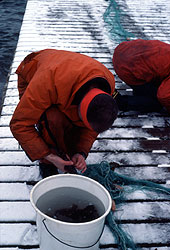
| 7/ Feeding the net into a bucket to take back to base and get the fish out |
 It was always good for some nice atmospheric pictures though, fishing in this manner. You can just about see a pointy thing about knee-high to the left of the black bucket. This is a harpoon head taken from Grytviken whaling station on South Georgia that we used to get people to collect if they called in there on their way south. These very heavy iron tips to the harpoon would be filled with explosives and screwed onto a harpoon that would reach to about a mans shoulder. We just used them as weights to keep the net down on the sea-bed. If it wasn't too cold, fish could be removed from the net on the ice and then the net re-set immediately. If it was too cold, the net would have to be taken back to base and then taken back out to be re-set. The difference about 2-3 hours work! We used to avoid taking the net back to base if it was at all possible.
|
| 8/ Juvenile Notothenia neglecta |
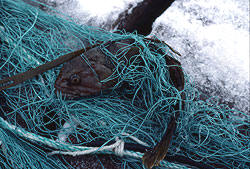 One of the common inshore species is this one, Notothenia neglecta, the subject of my particular studies. It was sometimes called "Antarctic Cod", but then I've seen that label attached to several other Antarctic fish species. With no native human population and a fish population that is pretty much totally unique to Antarctica, very few Antarctic fish actually have anything like a common name. The people who deal with them with any regularity are scientists rather than fishmongers as it would be anywhere else in the world. The result is that Antarctic fish tend only to have a Latin name. For reason I have never been able to fully understand this can greatly irritate some people. The conversation goes something like this:
|
| 9/ Getting a fish out of the net |
 A rapidly grabbed picture because I was supposed to be involved here in getting the fish out of the net and the fact I was taking pictures instead meant that I was having a break instead of doing the same uncomfortable job that my friends were doing. As our fish needed to be alive and in good condition we had to take care in extracting them from the nets and they seemed to have an awful lot of little hard protrusions and bits for the net to get caught on. It was a skill that you had to develop as a fish biologist, removing a sometimes very tightly caught fish with fingers that were at least half numb and getting worse. Very unpleasant at first, but of course, you got used to it and it was usually better to just carry on with fingers that at half worked than to keep warming them up which just made it worse.
|
| 10/ Summer fishing isn't as cold, but can still be very uncomfortable |
 Fishing in the summer months means from small boats. While it wasn't as cold as winter fishing, the sea keeps moving about in a way the sea-ice doesn't. Sea-sickness is fairly quickly overcome, unless your job was to coil the rope into the rope bucket as it came in, which could be difficult in a heavy swell. This was a calm day wind-wise, but there was about a 12ft (3.5m) swell and we really shouldn't have been out in it, but it was fun, especially as we would power up the waves as they came in and took off over the top of them. It meant getting the net in was easier too. Pull in as much rope as you could when the boat went down into a trough, then hold onto it for dear life as the up-swell came and lifted the boat and net with it, that way the swell did the work and you didn't have to.
|
| 11/ Small boat fishing means pulling the net up manually |
 Pulling a net up by hand can be hard, but not too bad if spread amongst a few of you. As driving along in the boat with buckets full of water isn't a great idea, the net was laid into an empty bucket and then we got back to base as quickly as we could before taking the fish out. The cold temperatures and wetness of the net kept the fish alive and well. We did have a small fishing launch with a powered capstan for hauling deep nets, but it was more a question of what mood you were in as to which was best to use as the capstan turned very slowly and you felt very sea-sick when watching the rope slowly coil into the bucket. We used the launch on nets that were further away from base rather than necessarily deeper.
|
| 12/ The net is then brought back to base where it can be laid out |
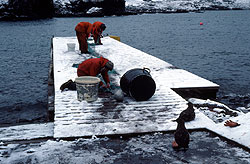 A fairly miserable day to get fish out of the net. Note the two skuas waiting patiently to pick up any tasty tit-bits that have also been brought up with the net. You often hear of how skuas are hardened criminals with no sense of decorum and will mug small children and old people for the slightest hint of food. However, ours were far more refined and would sit and wait like this, if nothing was forthcoming they would go on their way again. We had two pairs of base-skuas, the Reds and the Blues named for which side of the base they lived, there was a skua-landing pad outside the kitchen window, painted red on one side and blue on the other. One side was uphill (red) the other side downhill (blue). The skuas would fly the couple of hundred meters from their nest to the pad and get fed. If they were very fully fed, rather than make the effort to fly home, they would sometimes just flap down to ground level and walk home instead.
|
| 13/ Releasing fish from the net can be fiddly and uncomfortable! |
 But a necessary part of the job unfortunately. |
| 14/ It can take a long time to go through a 30m net |
 So the more people you could recruit to do this job the better. The problem was that you then had to help them in return when it was time for them to do their unpleasant job. |
| 15/ The net then needs to be straightened and stored neatly so it can be easily deployed again |
 After all the hard work, getting the net in, extracting the fish and putting them in the base aquaria, the last job was to sort the net for next time. Quite gentle and therapeutic after all the recent effort. The net had to be stored correctly as next time it was going to be used we'd be bouncing about in a small boat with hardly any elbow room setting it at dusk. |
   Extreme Cold Weather Clothing |

Lonely Planet travel guide Antarctica
 USA |
USA |
 UK
UK
 Free world delivery
The Endurance -
Shackleton's Legendary Expedition
Dramatization with original footage
DVD |
DVD
Cool Antarctica Store - Pictures, Shirts, Calendars, Cards etc.

Custom Search
|
Home | Site Map |
Pictures |
Antarctica
Stock Photos |
Facts |
History | Antarctica
Travel |
Antarctic Clothing |
Video |
Books |
Calendars |