
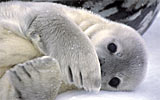
This may look very gory, but
it was the best way of getting food for sled dogs in
Antarctica. Crabeater Seals are very numerous, estimates are
difficult to arrive at as they cover huge regions of
Antarctica at a generally very low population density, there
are around 15 million of them - every other seal in the
world is a crabeater seal.
Because they are so widely
and thinly distributed, crabeaters were never targeted by
sealers unlike other seals that come together in large dense
groups during the breeding season.
I agree
(to a certain extent) with the environmental changes
which have resulted in the removal of the dogs and a
much greater effort to minimise man's impact on the
continent, but I get very hot and bothered when people
criticise the use of dogs.
Without
them the history of Antarctic exploration and
development would have been totally different. When the
environmental lobby started to get going in the early
1970s, the Stonners crew p***** ourselves laughing when
the US representatives suggested we should provide
details of all of the sledge campsites since the
inception of FIDS as they considered them
'contaminated'. They also suggested that we should be
collecting all of the dogs**t deposited on our journeys
and return it to base for disposal. Even taking the
coprophagous inclinations of sledge dogs into account we
calculated that the average sledge unit would produce in
the order of 10 lbs of dog & human s**t per day.
By the
end of the average summer journey (110-120 days) both
sledges in the unit would have been fully loaded with
c**p and no room for tents, gear, etc! I can just
imagine the reaction of the BAS pilots then if we had
depoted the c**p and asked them to fly it out to
Adelaide/Rothera.
Drummy Small - Stonington 1971 - 73
Previous
Image copyright Corel corporation.
This Image may not be saved or downloaded and may only be used for
viewing purposes on this website.